
Distribution Center vs. Warehouse
- By Cory Levins
- 1 nov 2021

Source: Juice Flair/Shutterstock.com
Summary
- The main differences between distribution centers and warehouses are their sizes and the lengths of time products are stored.
- Distribution centers have a higher flow velocity and prepare products for the end consumer, including packaging and order fulfillment.
- Warehouses store bulk products for wholesalers, manufacturers, importers and exporters.
The terms distribution center and warehouse are often used interchangeably. However, these facilities provide different services and use varying operational strategies to optimize their workflow.
Warehouses play an important role in the modern supply chain, particularly for wholesalers and manufacturing businesses that require extensive storage space. Distribution centers have evolved out of retail advancements, warehouse development and changing customer demands. They have also replaced traditional warehouses in several industries.
Consumers have higher expectations than ever when it comes to order fulfillment. This means that retailers must be prepared for rapid order processing and distribution. Many eCommerce businesses rely entirely on distribution centers for fast and efficient order fulfillment.
Differences Between Distribution Centers and Warehouses
Distribution centers are customer-focused, so their core operations are tailored to satisfy the end consumer. Warehouses are designed for medium- to long-term product storage. Some of the essential differences between distribution centers and warehouses include:
-
Primary Use of the Facility
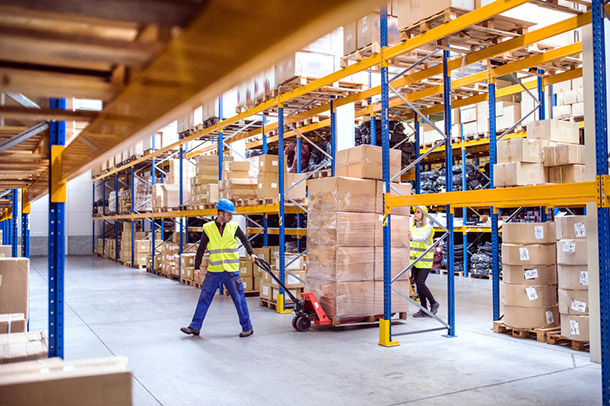
Warehouses are used primarily for product storage. They must be spacious, organized, efficient and well-managed. They must be outfitted with high-density storage systems and material handling equipment to streamline storage and retrieval processes.
Distribution centers store products but also provide value-added services, including packaging, product mixing, cross-docking and order fulfillment.
Source: Halfpoint/Shutterstock.com
-
Flow Velocity
It’s common for warehouses to store large quantities of products over an extended period. In distribution centers, products typically spend less time on shelves. There is a much higher flow velocity, with a greater quantity of products regularly moving through the distribution facilities.
-
Layout
Because warehouses and distribution centers serve different functions in the supply chain, they typically feature varying layouts to facilitate a more efficient workflow.
Warehouses focus on high-density storage solutions. Often, they use vertically optimized racking systems to maximize their use of floor space. They may also use storage systems like drive-in racking to minimize aisle space.
Distribution centers often feature more complex layouts because there are multiple operations in progress across the facility. Distribution-focused centers may use storage systems like pallet and carton flow racks or selective pallet racking to reduce inventory transit times. Loading bays are located close to picking and packing bays to allow for cross-docking.
-
Relationship to End Consumer
In most cases, warehouses send products to distribution centers to process and forward to the end consumer.
Although warehouses receive, store, manage, pick and ship goods, they typically deal with bulk items. Distribution centers are responsible for sorting items and packing them in custom shipping boxes before loading them for delivery to your doorstep.
-
Use of Technology
Distribution centers are busy facilities with a high product turnover. They require advanced technology and management systems to streamline the order fulfillment process, such as automated storage and retrieval systems.
Many warehouses are fully fitted with modern warehouse technology, such as temperature-controlled rooms, hazmat boxes and software. However, warehouses are primarily focused on efficient bulk storage and inventory control. Warehouse managers often use warehouse management software (WMS) to monitor inventory and manage logistics.
Find High-Quality, Tested Shipping Barrels from Air Sea Containers
What Businesses Benefit Most from Distribution Centers?
Distribution centers are beneficial for many types of businesses, especially online retailers or eCommerce companies. They offer efficient storage, streamlined fulfillment processes, multiple distribution channels and in-house management and technology. This is ideal for smaller businesses that may find it challenging to manage these complex, time-consuming and expensive operations.
Fulfilled By Amazon (FBA) businesses, eCommerce companies and online retailers benefit most from distribution centers because they receive comprehensive storage and shipping solutions from a single source. Without distribution centers, these types of businesses must manage logistics internally, which is costly and time-consuming.

Source: Aleksandar Malivuk/Shutterstock.com
What Businesses Benefit Most from Warehouses?
Warehouses are used by wholesalers, manufacturers, importers, exporters and logistics or transport companies for long-term storage. They safely store goods until they are needed for bulk transport to distribution centers, fulfillment facilities or other warehouses.
Although they are usually located close to highways, ports, airports, railways and main transport lines, warehouses are often situated on the outskirts of cities due to their size. They must be large enough to store bulk quantities of goods in a variety of packaging, from shipping barrels to rigid boxes. Warehouses should also be easily accessible by large delivery trucks.
Order Custom Shipping Boxes for Your eCommerce Business Today
Protect Your Goods with Quality Packaging
Whether you require a high-tech warehouse facility for long-term storage or a modern distribution center to handle order fulfillment, ensure you have adequate packaging and shipping supplies to keep your goods safe.
Air Sea Containers is a leading provider of shipping equipment, providing specialist packaging and quality supplies for a range of industries. Our product range includes IBCs, custom boxes, totes, temperature-controlled packaging and more.


