
Chemical Safety Masterclass: Symbols, Signs and Storage
- By Cory Levins
- 5 dic 2022

Summary:
- In 2016, OSHA switched from the HCS, a national safety pictogram system, to the globally-recognized GHS standard.
- There are nine GHS hazard categories, each with its own symbol and definition.
- Knowing the GHS categories, such as proper chemical segregation guidelines, is critical for chemical storage safety.
Knowledge and application of chemical safety procedures are critical in any environment where personnel routinely handle hazardous materials. The basic elements of chemical safety are clearly-labeled containers featuring appropriate safety symbols and signage. The information they convey tells personnel handling these materials how to transport and store them safely.
Here’s a breakdown of the most critical chemical safety symbols, signage systems and storage requirements.
The Globally Harmonized System: A Worldwide Standard for Chemical Safety Symbols
Before 2016, the Occupational Safety and Health Administration (OSHA) maintained a national standard for chemical symbols in the Hazard Communication Standard (HCS or HazCom), used nationwide since 1983.
Many of the chemical symbols and associated standards in the HCS were similar to those used in other parts of the world. However, there were still many differences with international symbol systems, creating communication issues.
To address the potential dangers of these issues, OSHA announced in 2016 that the HCS would be updated to adopt the same standards as the Globally Harmonized System (GHS) to improve international chemical safety communication.
Before OSHA aligned its chemical safety communication standards to the GHS, you could find GHS symbols featured on the Safety Data Sheets produced by international companies. Today, OSHA requires using GHS symbols in the United States, facilitating global shipping safety.
List of GHS Hazard Categories and Symbols
The Globally Harmonized System uses a set of nine textless basic symbols to categorize hazardous materials by the type of potential danger they represent. All nine symbols are in black and white, surrounded by the outline of a red diamond.
These symbols are designed explicitly to be instantly recognizable, highly visible when printed or placed on hazmat shipping supplies and easily readable by anyone worldwide, regardless of language or cultural background.
If necessary, a GHS symbol may be accompanied by what is termed as a “signal word,” a single English-language word representing the relative severity of the danger. There are only two signal words: “DANGER” for high-risk substances and “WARNING” for medium-risk materials. The lack of a signal word indicates low-risk hazardous materials.
In addition to the signal word, a specific substance may be assigned to a hazard statement, a stock English-language phrase designating the exact nature of the danger. Each hazard statement is assigned to a unique identifier called H-code (the letter H followed by three numbers) for ease of reference. For example, H-code H207 is a fire or projection hazard with an increased risk of explosion if the desensitizing agent is reduced.
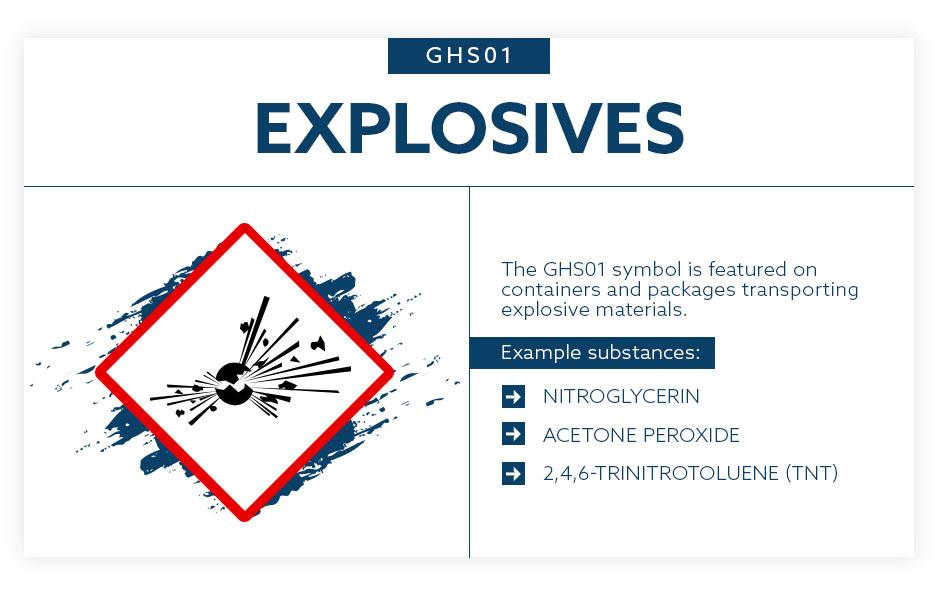
GHS01: Explosives
This pictogram features an exploding bomb or spherical object projecting flying shrapnel and fragments. The GHS01 symbol is featured on containers and packages transporting explosive materials.
Hazardous materials in this category correspond to Class 1 Explosives (orange hazmat placards) as per the definition in the USDOT Hazmat Class system, including explosives in divisions 1.1, 1.2, 1.3, 1.4, 1.5 and 1.6.
Although all types of organic peroxides correspond to USDOT Class 5.2 Organic Peroxides, only containers transporting Types A and B organic peroxides must feature the GHS01 explosive.
Example substances:
- Nitroglycerin
- Acetone peroxide
- 2,4,6-trinitrotoluene (TNT)
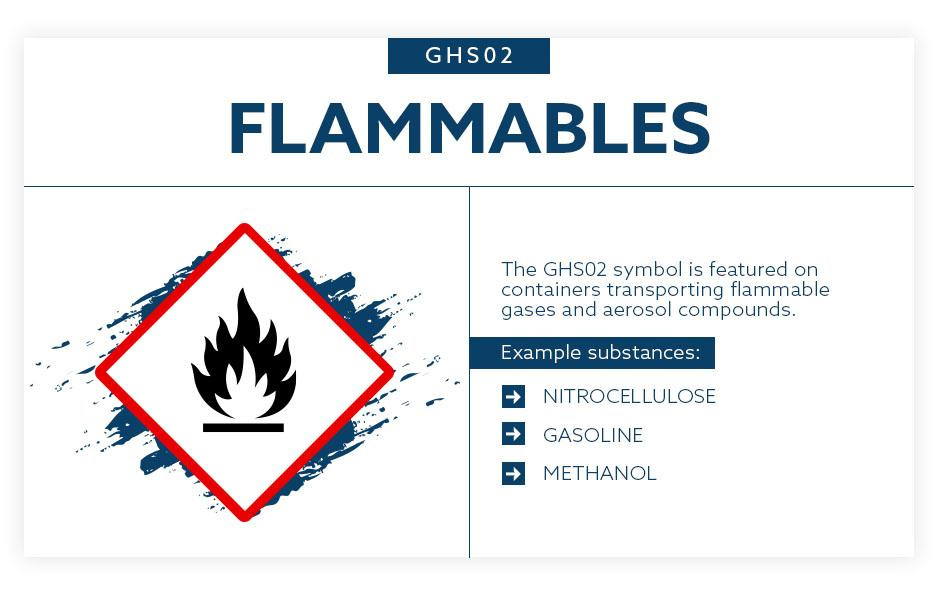
GHS02: Flammables
This pictogram features a black line with a large flame emanating from it. The GHS02 symbol is featured on containers transporting flammable gases and aerosol compounds. For comparison, most compounds in this category feature an HMIS Flammability rating of at least 1.
Gaseous hazardous materials in this category typically correspond to USDOT Class 2.1 flammable gases (red placard), except if they are categories A or B non-flammable chemically unstable gases or category 3 aerosols. In the latter case, they correspond to USDOT Class 2.2 non-flammable gases (green placard).
Non-gaseous hazardous materials in this category typically correspond to USDOT Class 3 flammable liquids (red placard) or USDOT Class 4.1 flammable solids (red-and-white placard), depending on their chemical state.
Flammable substances categorized as pyrophoric or self-heating mixtures may correspond to USDOT Class 4.2 Spontaneously Combustible Solids (red-and-white placard) instead.
Flammable substances emitting flammable gases when in contact with water correspond to USDOT 4.3 Dangerous When Wet (blue placard).
Containers transporting organic peroxides, types B, C, D, E and F, must correspond to USDOT Class 5.2 Organic Peroxides and must feature the GHS02 label. If a container is used to transport Type B organic peroxides (may cause a fire or an explosion if heated), it must feature both the GHS01 and GHS02 labels.
Example substances:
- Nitrocellulose
- Gasoline
- Methanol
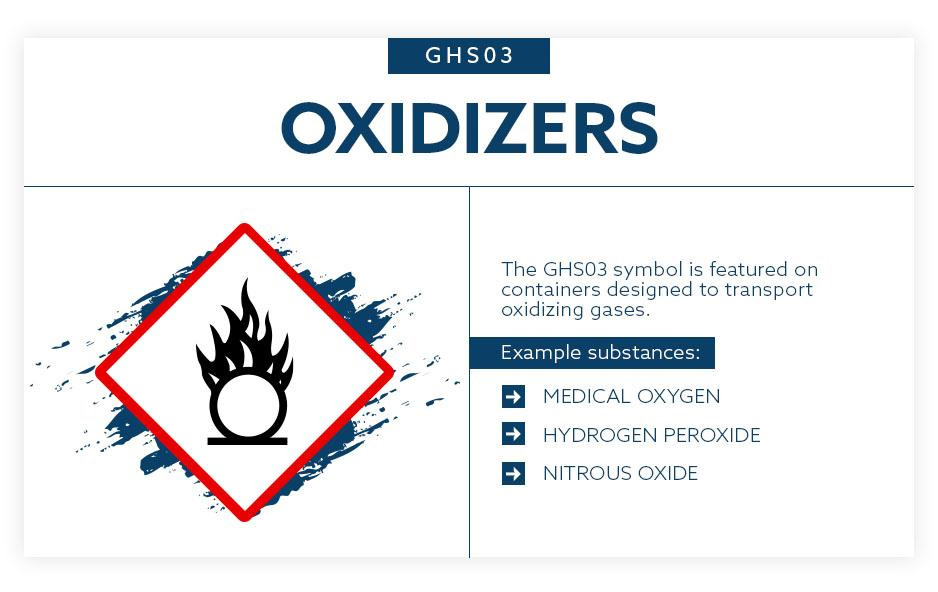
GHS03: Oxidizers
This pictogram features a black line with a burning circular outline known as the “flame over circle.” The GHS03 symbol is featured on containers designed to transport oxidizing gases.
Hazardous materials in this category correspond to USDOT Class 5 oxidizers or USDOT Class 2.2 oxygen (both yellow placards), depending on the substance.
Example substances:
- Medical oxygen
- Hydrogen peroxide
- Nitrous oxide
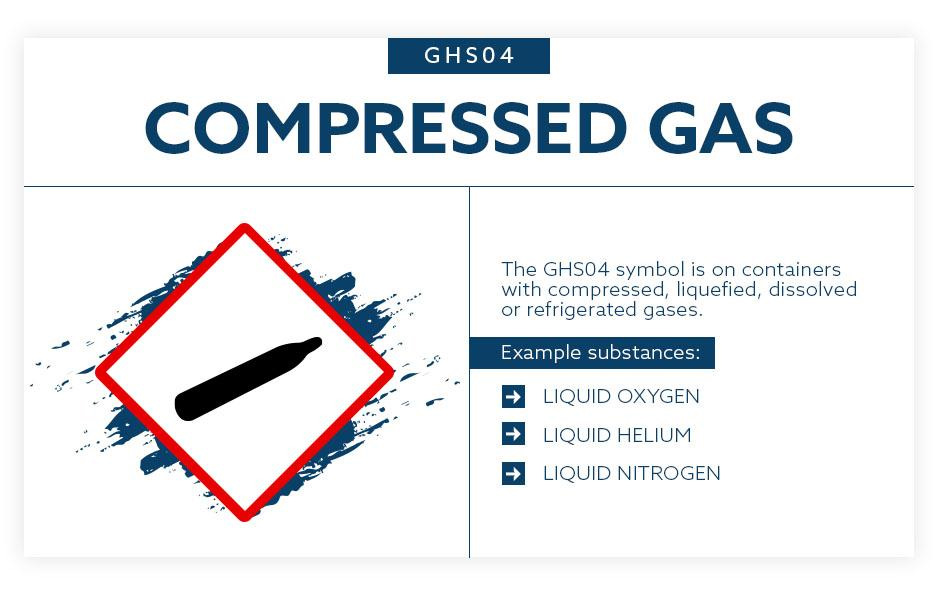
GHS04: Compressed Gas/Gases Under Pressure
This pictogram features the silhouette of a cylindrical gas tank. The GHS04 symbol is featured on containers transporting tanks filled with compressed, liquefied, dissolved or refrigerated gases.
Typically, a GHS04 material falls into USDOT Class 2 non-flammable gases. However, some GHS04 materials may overlap with other categories. For example, liquid oxygen is classified under GHS03 and GHS04, making it USDOT Class 2 and 5.1.
Example substances:
- Liquid oxygen
- Liquid helium
- Liquid nitrogen
GHS05: Corrosive
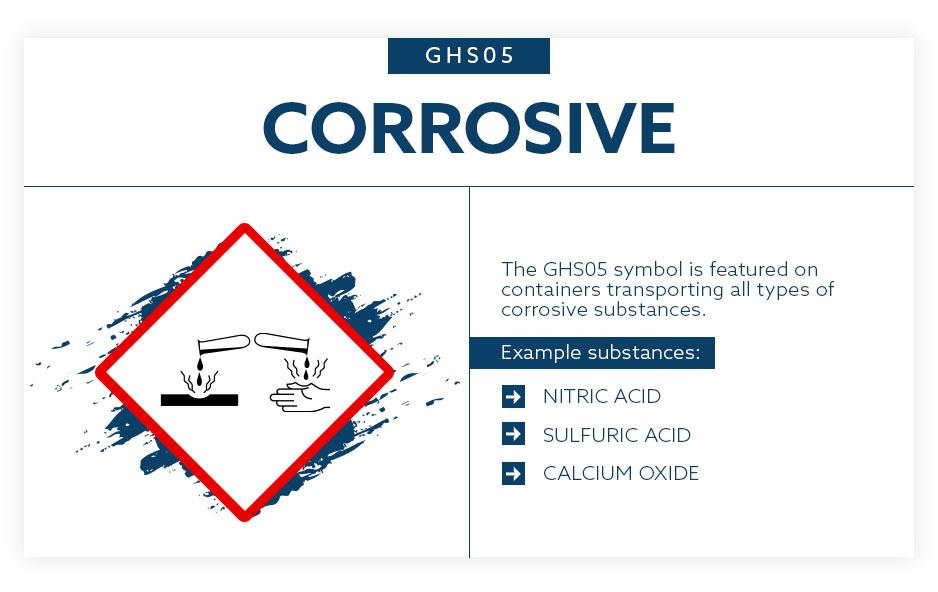
This pictogram features two pipettes dispensing drops of liquid. The one on the left is corroding a solid rectangular object and the one on the right is damaging a human hand. The GHS05 symbol is featured on containers transporting all types of corrosive substances.
There are two distinct types of corrosive chemicals: corrosives to metals and skin corrosives/irritants. Although substances in both categories correspond to USDOT Class 8 corrosives, only corrosives to metals and category 1 skin corrosives require the GHS05 label.
Example substances:
- Nitric acid
- Sulfuric acid
- Calcium oxide
GHS06: Toxic
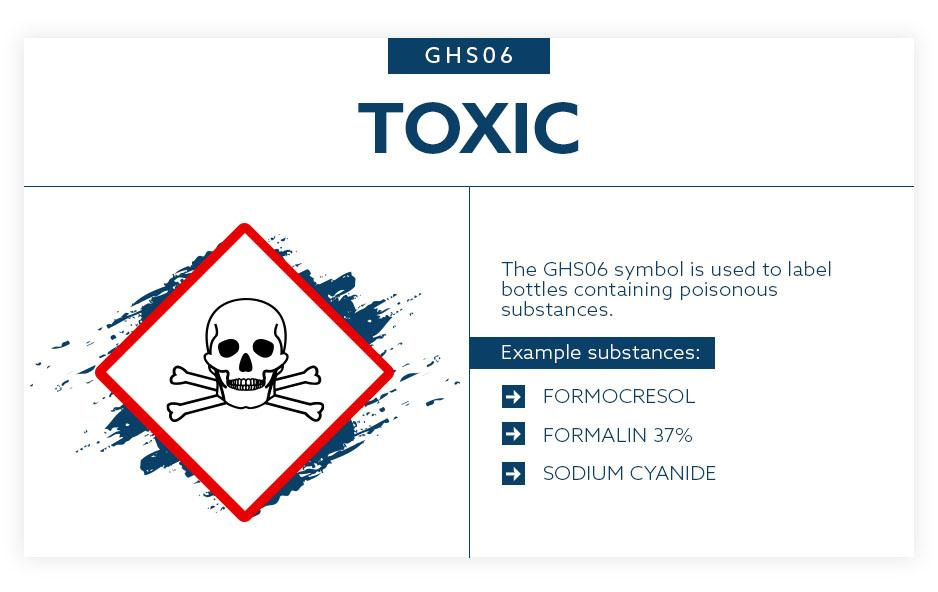
This pictogram features the oldest codified hazardous material symbol in history, the skull-and-crossbones. Although this symbol has been used to represent death and deadly substances since the Middle Ages, the American Pharmaceutical Association first mandated the usage of this symbol in 1853 to label bottles containing poisonous substances.
Since then, the definition of this symbol has evolved and is now an internationally recognized symbol for toxic and poisonous substances of all types (solids, liquids, gases). As per the current definitions, substances featuring a GHS06 label correspond to USDOT Class 6.1 Poisons.
Example substances:
- Formocresol
- Formalin 37%
- Sodium cyanide
GHS07: Harmful
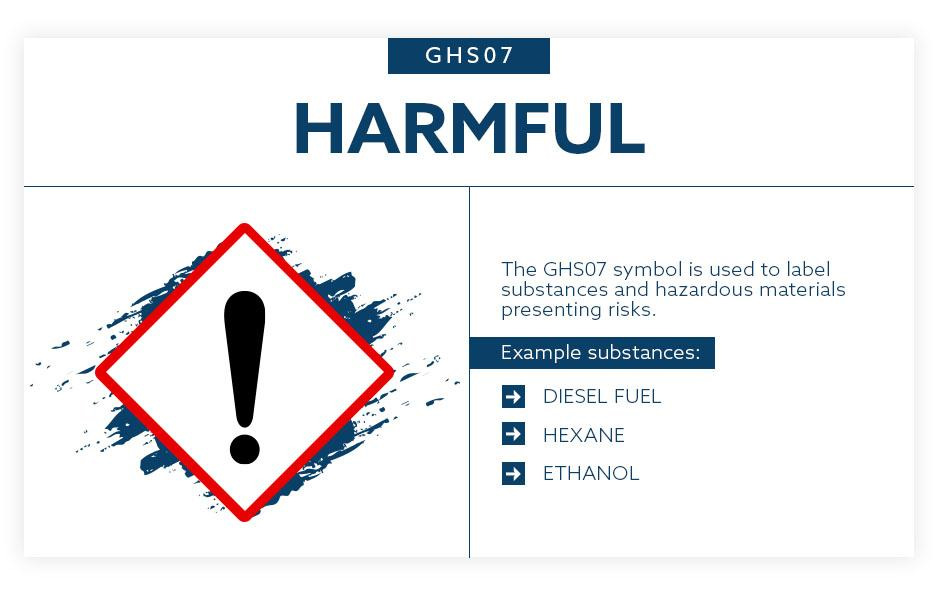
This pictogram features a general-purpose exclamation mark symbol. Unlike the exclamation mark in other contexts like road danger signs, this pictogram does not represent a general, non-specific danger to human life. Instead, it is used to label substances and hazardous materials presenting any of the following risks:
- Substances with acute toxicity under the thresholds that would classify them in the GHS06 category
- Skin irritation (mild to moderate)
- Eye irritation
- Skin sensitization
- Toxicity to specific target organs following a single exposure, such as respiratory tract irritation or narcotics
According to the GHS guidelines, manufacturers cannot use the GHS07 symbol if the substance’s SDS already features the GHS06 symbol. Additionally, the GHS07 symbol cannot be used to label a substance for skin or eye irritation if it already has a GHS05 symbol or to label a substance causing skin sensitization if it already features a GHS05 symbol.
Example substances:
- Diesel fuel
- Hexane
- Ethanol
GHS08: Health Hazard
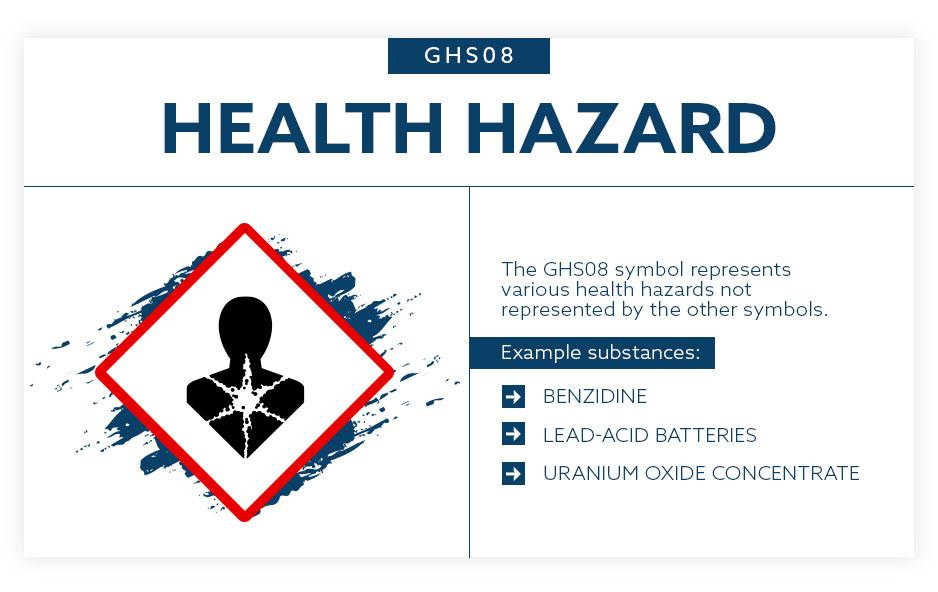
This pictogram features a human silhouette with a star-shaped tear centered over the silhouette’s throat. The GHS08 symbol represents various health hazards not represented by the other symbols, such as respiratory sensitization, mutagens, carcinogens, dangers to reproductive health and damage to specific target organs.
Substances in this category do not have a corresponding USDOT Hazmat class. They vary from material to material instead.
Example substances:
- Benzidine (USDOT Class 6: Poison)
- Lead-acid batteries (USDOT Class 8: Corrosive)
- Uranium oxide concentrate (USDOT Class 7: Radioactive)
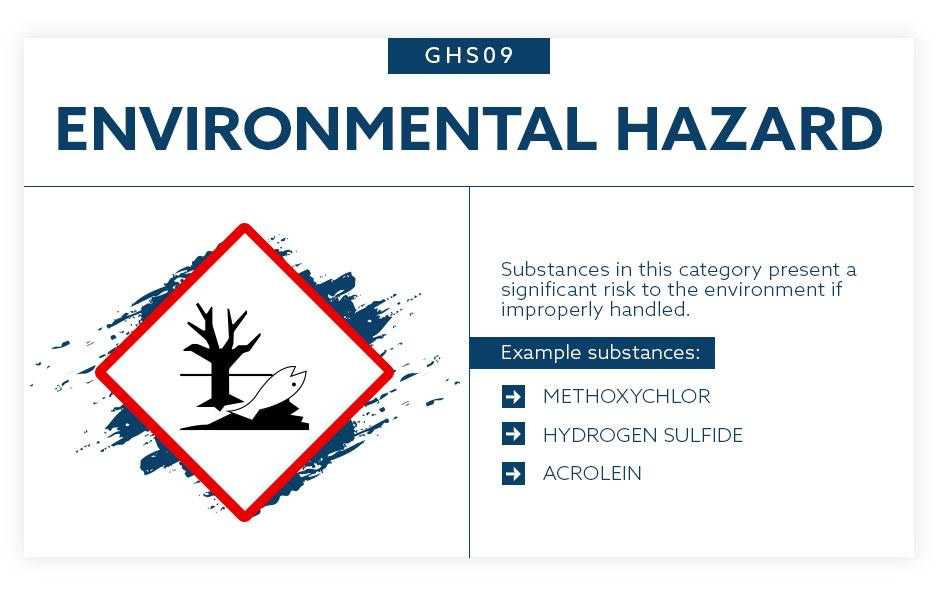
GHS09: Environmental Hazard
This pictogram represents a dead tree, a dark-colored river and a dead fish, intended to evoke a polluted environment. Substances in this category present a significant risk to the environment if spilled, leaked, dumped or improperly stored.
Like GHS08, GHS09 substances do not correspond to a specific USDOT Hazmat class. Each material is evaluated and categorized on a case-by-case basis.
Example substances:
- Methoxychlor (USDOT Class 9: Miscellaneous hazardous materials)
- Hydrogen sulfide (USDOT Classes: 2.1 Flammable gas and 2.3 Inhalation hazard)
- Acrolein (USDOT Classes: 3 Flammable liquid and 6.1 Poison)
Chemical Storage Guidelines
While proper labeling is critical for identifying and transporting hazardous materials, knowledge of appropriate storage safety and requirements is just as necessary. To know how to get a hazmat endorsement, you’ll need to become familiar with chemical storage safety requirements.
General Guidelines
OSHA regulates the rules and requirements regarding chemical storage and inventories of hazardous materials. The agency also regularly publishes non-mandatory recommendations for extra safety.
Here are the guidelines all facilities storing chemicals and hazardous materials should follow:
- All employees handling hazardous materials must have received hazmat training.
- All chemical substances stored on the premises must be accompanied by a Safety Data Sheet (SDS).
- Safety Data Sheets must be readily available to any employee.
- Store all chemical substances in a safe location on stable, level shelving or chemical storage cabinets.
- Do not store chemicals on the floor, ledges, windows, balconies or egress pathways.
- Keep chemical storage cabinets away from direct exposure to sunlight or heat sources.
- Store all hazardous materials below eye level to prevent dangerous spillages.
- Never leave a chemical storage cabinet open unless you’re currently dispensing or adding materials.
- Always use appropriate containers for each chemical or hazardous substance.
Chemical Segregation
Respecting the principles of chemical segregation is a critical element of chemical safety. The objective of chemical segregation is to prevent hazardous materials from exposure to one another, causing unintended reactions.
When storing chemicals, you may need to refer to both their GHS hazard categories and their USDOT hazmat classes to ensure storage compatibility.
The following guidelines are valid in most circumstances:
- Substances belonging to the same GHS category and USDOT classes are usually safe to store together unless specified otherwise by a specific substance’s SDS.
- GHS01 Explosives: Store away from all other substances in a separate area. Keep the substances protected from impacts, falls and heavy shocks.
- GHS02 Flammables: Store away from acids, bases, oxidizers and poisons.
- GHS03 Oxidizers: Store away from reducing agents, flammables and organic materials.
- GHS04 Compressed gases: Secure all tanks upright using double-strap or double-chain cylinder holders.
- Flammable gases: Keep at least 20 feet away from oxidizing gases, toxic gases and oxidizing solids.
- Oxidizing gases: Keep at least 20 feet away from flammable gases and heat sources.
- Poisonous gases: Store away from flammable gases and oxidizing gases.
- GHS05 Corrosives: Use separate storage cabinets for acids and bases. Storage cabinets for all corrosives must be chemically resistant. Acid cabinets should not have metal shelves due to the risk of corrosion.
- Inorganic acids: Store away from flammables, oxidizers, organic acids and all bases.
- Organic acids: Store away from flammables, oxidizers, inorganic acids and all bases.
- Oxidizing acids: Store away from flammables, inorganic acids, organic acids and all bases.
- Bases: Store away from flammables, oxidizers, poisons and all acids.
- GHS06 Toxic and GHS07 Harmful: Store away from corrosives and flammables in a cool, dry, well-ventilated area. Secondary containers should feature chemically-resistant materials. Verify each substance’s SDS (specifically, sections 7 and 10) for specific compatibilities.
- GHS08 Health Hazard: Store away from corrosives and flammables in chemically-resistant containers and inside a secure, physically separated location. Limit access to the storage area to users trained to handle such materials.
- GHS09 Environmental Hazard: No specific segregation requirements, although you should observe all general chemical safety guidelines.
Store and Transport Chemicals Safely with AirSea
At Air Sea Containers, we specialize in UN-certified packaging materials and containers. Our products are designed explicitly to store and safely transport hazardous materials of all types.
Browse our selection of UN-rated boxes, jerricans, bottles, pails, cans, shipping barrels, drums and IBCs and pack virtually any hazardous material. We also offer a selection of specialized packaging materials such as infectious and biological substance packing kits, biofreeze packs and other temperature-controlled packaging solutions.
We also offer custom hazmat boxes, labels and other products if our standard inventory does not match your needs. Contact us today for a quote or more information.
Image Credits
ValterDesign/Shutterstock.com
Technicsorn Stocker/Shutterstock.com
checha/Shutterstock.com
worawit_j/Shutterstock.com
Artur Wnorowski/Shutterstock.com


