
4 Things to Know About Using Vermiculite When Shipping Hazardous Materials
- By Cory Levins
- 10 abr 2019

Although most people associate shipping and packaging materials with foam, plastic and other synthetic substances, nature provides a surprising number of great packaging materials. The mineral called vermiculite is one—its numerous useful properties have made it a perennial favorite of shippers, particularly in the hazmat sector.
Air Sea Containers offers vermiculite products for shippers who need moisture control, cushioning, or any of several other features vermiculite offers. If you’re considering whether vermiculite is right for you—and especially if you’re doing hazmat shipping—here are four key things you need to know.
Here’s a quick rundown of the basic facts about vermiculite:
For many decades, shippers have been aware of vermiculite’s numerous benefits and have incorporated it into their shipping solutions. You’ll often find it used to ship highly sensitive goods that need to be protected from moisture, impacts and other hazards.
So, what are these beneficial properties of vermiculite that make it so popular as a shipping material? Take a look:
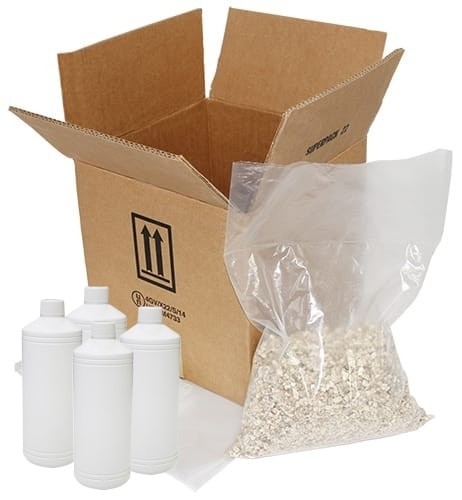
Thanks to these numerous protective qualities, vermiculite is part of the UN 4GV packaging standards for shipping dangerous goods. Air Sea offers it as part of several of our 4GV packaging kits, included with a durable corrugated overpack box and other materials such as plastic bottles.

Vermiculite is manufactured and processed in several different grades. Air Sea offers two options for vermiculite grades, Grade 4A and Grade 3A. (Finer grades are used for other applications such as gardening and insulation.)
Vermiculite is a generally safe material, but repeated exposure to large amounts of vermiculite dust should be avoided. That’s why Air Sea offers non-dusty vermiculite, to better protect our customers’ safety.
Although vermiculite is generally extremely safe, there are a few small concerns that are worth noting. Some experts recommend that, for example, lithium ion batteries should not be shipped with vermiculite. As you would with any product, check the knowledge base about best practices for shipping your goods and whether vermiculite is a recommended option.
As a final note, you may have heard about concerns regarding vermiculite being contaminated with asbestos. These were the result of vermiculite from a single mine in Montana that had grown alongside asbestos materials; the mine shut down in 1990, and, since then, vermiculite producers have taken precautions to ensure that their products contain no asbestos. All of Air Sea Containers’ vermiculite is classified as Asbestos Free.
With the many advantages that vermiculite offers hazmat shippers, it’s worth exploring if it’s the right choice for your shipping application. Need more information on this fascinating and useful material? Call Air Sea Containers at (866) 596-9448 for expert guidance on our vermiculite options.
Air Sea Containers offers vermiculite products for shippers who need moisture control, cushioning, or any of several other features vermiculite offers. If you’re considering whether vermiculite is right for you—and especially if you’re doing hazmat shipping—here are four key things you need to know.
1. Vermiculite is a mineral that’s commonly used as loose fill material for shipping and packaging.
Here’s a quick rundown of the basic facts about vermiculite:
- A granular, crumbly mineral with a spongy internal structure that contains magnesium, silicon, aluminum, and several other elements.
- Mined from the earth, mainly in South Africa, the U.S. and China.
- Used by shippers around the world for its many useful properties, including absorbing moisture and cushioning impacts.
- Available in a variety of coarseness grades.
For many decades, shippers have been aware of vermiculite’s numerous benefits and have incorporated it into their shipping solutions. You’ll often find it used to ship highly sensitive goods that need to be protected from moisture, impacts and other hazards.
2. Vermiculite has several benefits that can make it a great shipping material, depending on your applications.
So, what are these beneficial properties of vermiculite that make it so popular as a shipping material? Take a look:
- It’s great for absorbing moisture. Vermiculite’s spongy internal structures draw in moisture, keeping the moisture away from items sensitive to it. It also means that should a liquid spill happen, vermiculite can help to control it by aiding in liquid absorption.
- It’s chemically inert. Vermiculite is almost entirely non-reactive and does not break down or emit gases. In the event of a chemical spill, you can almost always trust vermiculite not to create dangerous reactions that make the situation worse.
- It’s flame retardant. Due to its flame-retardant nature, vermiculite is great for goods where flammability is a concern.
- It’s spongy and can be compressed. The interior structures of vermiculite are accordion-like layers that can be pressed together before re-expanding. That makes it great for impact cushioning due to its ability to absorb shocks and return to its original form.
- Its lightweight nature can help reduce shipping costs. Vermiculite is extremely light, offering considerable potential savings for bulk shipping where every gram counts.
- It’s cost-effective. Air Sea offers 4 cubic foot bags of Grade A4 vermiculite for under $30, making it a smart solution for cost-conscious shippers.
Thanks to these numerous protective qualities, vermiculite is part of the UN 4GV packaging standards for shipping dangerous goods. Air Sea offers it as part of several of our 4GV packaging kits, included with a durable corrugated overpack box and other materials such as plastic bottles.
3. Vermiculite is available in several different grades.
Vermiculite is manufactured and processed in several different grades. Air Sea offers two options for vermiculite grades, Grade 4A and Grade 3A. (Finer grades are used for other applications such as gardening and insulation.)
- Grade 4A (Extra Coarse Vermiculite): This is the coarsest grade of vermiculite available, with the least amount of dust. This is the preferred grade for many shippers, and it’s perfect for the most demanding shipping applications.
- Grade 3A (Coarse Vermiculite): Grade 3A is slightly smaller than 4A, but still offers excellent performance. Air Sea’s Grade 3A vermiculite is a special non-dusty preparation.
Vermiculite is a generally safe material, but repeated exposure to large amounts of vermiculite dust should be avoided. That’s why Air Sea offers non-dusty vermiculite, to better protect our customers’ safety.
4. Vermiculite is one of the safest packaging materials—but there are a few things to be aware of.
Although vermiculite is generally extremely safe, there are a few small concerns that are worth noting. Some experts recommend that, for example, lithium ion batteries should not be shipped with vermiculite. As you would with any product, check the knowledge base about best practices for shipping your goods and whether vermiculite is a recommended option.
As a final note, you may have heard about concerns regarding vermiculite being contaminated with asbestos. These were the result of vermiculite from a single mine in Montana that had grown alongside asbestos materials; the mine shut down in 1990, and, since then, vermiculite producers have taken precautions to ensure that their products contain no asbestos. All of Air Sea Containers’ vermiculite is classified as Asbestos Free.
With the many advantages that vermiculite offers hazmat shippers, it’s worth exploring if it’s the right choice for your shipping application. Need more information on this fascinating and useful material? Call Air Sea Containers at (866) 596-9448 for expert guidance on our vermiculite options.


