
Distinguishing Dangerous Goods: Hazard Class 7
- By Cory Levins
- 20 oct 2019
When employees are handling hazardous goods, there’s no room for mistakes or accidents. That’s why every business that ships these goods have the responsibility to learn the specific rules and to implement the right procedures for shipping each substance safely.
Hazmat expertise is an important part of what we do at Air Sea Containers, so we take every opportunity to help get the word out about the most vital topics in hazmat shipping. Today, we’ll talk about another important UN hazmat rating: Hazard Class 7 for radioactive materials. This category needs numerous special considerations, so let’s dive in and find out what you need to know.
In the context of transportation, the U.S. Nuclear Regulatory Commission (NRC) defines “radioactive materials” as any substance with a specific activity greater than 0.002 microcuries per gram. (Check out the NRC’s resources on radioactive decay and specific activity to learn more about these concepts.)
Many different goods and substances fall into Hazard Class 7, including:
Many items in Hazard Class 7 are typically not shipped by private businesses. For those that are, however, it’s critical to know the rules.
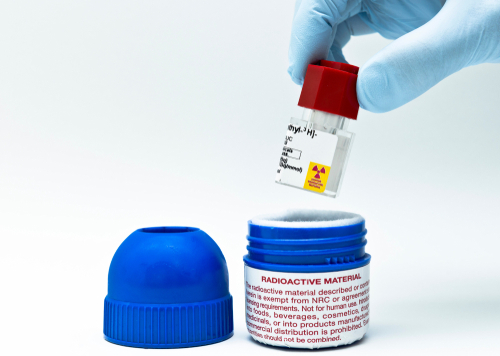
Radioactive materials, even in small quantities, often require a level of care above and beyond even normal hazmat precautions. Furthermore, businesses that ship these materials need extensive familiarity with the specific rules and best practices for shipping each individual substance.
For starters, you’ll need to learn the rules for each individual substance you ship. Take a look at the U.S. DOT Hazmat Tables. These tables provide a quick rundown of the shipping regulations you’ll need to follow for different types of radioactive substances, including where the material can be stored, cautions to be observed and more.
Many key regulations for Class 7 goods are based on which category your goods fall into on several different scales. We’ll talk about two of the most important next.

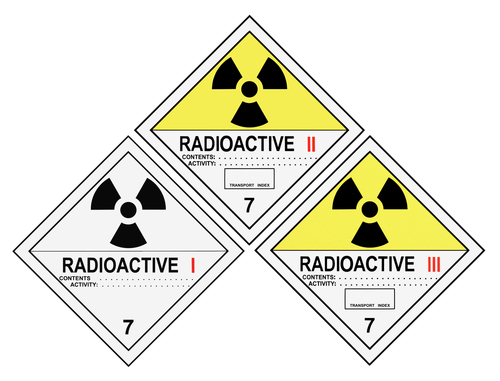
Outside of material-specific regulations, you’ll also need to determine which of two important classes your goods fall into. The first is the NRC’s three-tier radioactivity level classification. This is determined by measuring radiation levels outside the package and assigning it to the Radioactive I, II or III categories. Each category has a separate label and requires separate radioactive packaging labels, as well as its own shipping procedures.
Radioactivity levels inside the package, meanwhile, are laid out in a five-tier packaging classification system. Different levels of radioactivity are specified in the U.S. DOT’s Activity Limits Chart, and a given quantity of a given substance is classified according to where its specific activity falls on the chart:
Shipping Class 7 hazmat means using only the most durable and reliable packaging materials, and Air Sea Containers has you covered with our best-in-class hazmat shipping selection:
Need help designing a custom packaging solution for your Hazard Class 7 goods? Our hazmat experts can help you find what you need. To learn more about our solutions, call us at (866) 596-9448 or contact us online to get started with a quote today.
Hazmat expertise is an important part of what we do at Air Sea Containers, so we take every opportunity to help get the word out about the most vital topics in hazmat shipping. Today, we’ll talk about another important UN hazmat rating: Hazard Class 7 for radioactive materials. This category needs numerous special considerations, so let’s dive in and find out what you need to know.
What Goods Are in Hazard Class 7?
In the context of transportation, the U.S. Nuclear Regulatory Commission (NRC) defines “radioactive materials” as any substance with a specific activity greater than 0.002 microcuries per gram. (Check out the NRC’s resources on radioactive decay and specific activity to learn more about these concepts.)
Many different goods and substances fall into Hazard Class 7, including:
- Smoke detectors (most of which contain the radioactive element americium)
- Medical and scientific isotopes used for radiographic imaging and radiation therapy
- Radioactive metals such as uranium, plutonium and cobalt
- Spent nuclear fuel
Many items in Hazard Class 7 are typically not shipped by private businesses. For those that are, however, it’s critical to know the rules.
Rules of Shipping for Hazard Class 7
Radioactive materials, even in small quantities, often require a level of care above and beyond even normal hazmat precautions. Furthermore, businesses that ship these materials need extensive familiarity with the specific rules and best practices for shipping each individual substance.
For starters, you’ll need to learn the rules for each individual substance you ship. Take a look at the U.S. DOT Hazmat Tables. These tables provide a quick rundown of the shipping regulations you’ll need to follow for different types of radioactive substances, including where the material can be stored, cautions to be observed and more.
Many key regulations for Class 7 goods are based on which category your goods fall into on several different scales. We’ll talk about two of the most important next.
Categorizing Your Class 7 Goods
Outside of material-specific regulations, you’ll also need to determine which of two important classes your goods fall into. The first is the NRC’s three-tier radioactivity level classification. This is determined by measuring radiation levels outside the package and assigning it to the Radioactive I, II or III categories. Each category has a separate label and requires separate radioactive packaging labels, as well as its own shipping procedures.
Radioactivity levels inside the package, meanwhile, are laid out in a five-tier packaging classification system. Different levels of radioactivity are specified in the U.S. DOT’s Activity Limits Chart, and a given quantity of a given substance is classified according to where its specific activity falls on the chart:
- Excepted Packaging: Substances with over 0.002 microcuries of radioactivity that meet the government’s limited quantity standards can be shipped with a normal “strong tight container” to keep them secure, but must include a UN identification number. These packages must meet the U.S. government’s 49 CFR 173.421 standards.
- Industrial Packaging: Low-level radioactive substances that don’t meet limited quantity standards but have similarly low risks must use so-called “industrial packaging.” Industrial packaging must meet 49 CFR 173.411 standards.
- Type A Quantity Packaging: Substances that have low-to-medium levels of radioactivity. Packaging must be highly durable and secure and must meet the standards outlined in 49 CFR 173.412.
- Type B Quantity Packaging: Substances with medium-to-high levels of radioactivity. Type B packaging typically involves materials like lead and concrete, and it must meet the standards of 49 CFR 173.413. Businesses who need Type B packaging material usually work with specialty packaging manufacturers.
- Highway Route Controlled Quantity: The largest quantities of highly radioactive material require high levels of special transportation precautions and are typically shipped only with the assistance of government and military organizations.
Hazard Class 7 Shipping Materials from Air Sea Containers
Shipping Class 7 hazmat means using only the most durable and reliable packaging materials, and Air Sea Containers has you covered with our best-in-class hazmat shipping selection:
- Our full range of UN-compliant hazmat packaging includes 4G and 4GV rated boxes, hazardous waste packaging and complete shipping kits with multi-layer protection.
- Vermiculite is a mineral widely used as a void fill that offers excellent shock and moisture absorption. Most importantly, vermiculite is highly stable and chemically inert, making it an ideal non-reactive cushioning material for radioactive goods.
- Hazard Class 7 labels and placards for Radioactive Category I-III are another essential shipping material for radioactive materials. Depending on the category, your shipments might be required to display these labels on the inner packaging, outer packaging, transportation vehicle or all three. Our colorful, durable peel-and-stick vinyl labels and placards are an ideal choice.
Need help designing a custom packaging solution for your Hazard Class 7 goods? Our hazmat experts can help you find what you need. To learn more about our solutions, call us at (866) 596-9448 or contact us online to get started with a quote today.


