
Steps to Supply Chain Sustainability: Eco-Friendly Packaging, Setting Green Goals and More
- By Cory Levins
- 8 may 2019

The ethos of greener and more sustainable commerce is no longer just for organic grocery co-ops and other traditionally “green” businesses. Rather, it’s taking hold at every level of numerous industries around the world. Consumers, particularly millennials, are willing to pay more for goods that are produced and packaged according to ethical and sustainable standards. And, moreover, the benefits don’t stop there: businesses can often also find substantial cost savings by streamlining and reshaping their supply chains to reduce waste and create more efficient practices.
The road to developing truly sustainable commerce is long and not always easy, but, at Air Sea Containers, we’re committed to helping our customers push forward into the exciting and productive world of sustainable supply chains. We’re one of the shipping and packaging industry’s leading suppliers of eco-friendly packaging materials. From biodegradable air pillows to eco-friendly refrigeration gel packs, we’re proud to offer products that help our customers create a cleaner and more efficient future.
If you’re interested in moving your supply chain toward greater sustainability, take a look at these helpful tips to get you going in the right direction, from packaging to transportation and beyond. Air Sea is a proud partner in sustainable packaging for our clients—and these are some of the steps that business leaders everywhere are taking to improve their sustainability and their relationship with the planet that we all share.
 These are all major long-term undertakings that you shouldn’t try to rush. However, the sooner you start, the sooner you’ll likely begin to see results! Those results can be much more significant than you might realize. Implementing sustainability practices at PepsiCo saved the company $375 million in the long run, while consumer goods giant Unilever found that its sustainability-focused brands drove over 60 percent of the company’s 2016 growth.
It’s also useful to consider that, for most businesses, the supply chain is actually more like a web—a complex and interconnected structure. That means that, in most cases, there are numerous opportunities to become more sustainable, even if you’re working little by little. At Air Sea Containers, we like to help by providing our customers with flexible and creative solutions that work wherever and whenever they need them the most.
These are all major long-term undertakings that you shouldn’t try to rush. However, the sooner you start, the sooner you’ll likely begin to see results! Those results can be much more significant than you might realize. Implementing sustainability practices at PepsiCo saved the company $375 million in the long run, while consumer goods giant Unilever found that its sustainability-focused brands drove over 60 percent of the company’s 2016 growth.
It’s also useful to consider that, for most businesses, the supply chain is actually more like a web—a complex and interconnected structure. That means that, in most cases, there are numerous opportunities to become more sustainable, even if you’re working little by little. At Air Sea Containers, we like to help by providing our customers with flexible and creative solutions that work wherever and whenever they need them the most.
 Not all of these will be applicable to every situation, and, in some cases, the realities of doing business will mean that you have to pick your battles. Conversations with suppliers should be mutually open and informative. If your suppliers are unwilling or unable to participate in your sustainability efforts, it might be time to look elsewhere.
For businesses who are having trouble locating sustainably sourced materials, it can be beneficial to look into the many organizations that provide guidance on sustainable sourcing, such as Sedex. These organizations employ sustainability and sourcing experts to provide professional guidance to firms looking to transition their supply chain into a sustainable model.
Not all of these will be applicable to every situation, and, in some cases, the realities of doing business will mean that you have to pick your battles. Conversations with suppliers should be mutually open and informative. If your suppliers are unwilling or unable to participate in your sustainability efforts, it might be time to look elsewhere.
For businesses who are having trouble locating sustainably sourced materials, it can be beneficial to look into the many organizations that provide guidance on sustainable sourcing, such as Sedex. These organizations employ sustainability and sourcing experts to provide professional guidance to firms looking to transition their supply chain into a sustainable model.
 Note that all of these are big-picture statistics, and most can be broken down much further to more precisely identify areas for improvement. If you don’t have a robust reporting infrastructure in place to capture your most important sustainability KPIs, you’ll probably want to look into getting a system that will allow you to gather data on whether your efforts are producing results.
 Another great option for more efficient, cost-effective, and sustainable packaging is to design your own custom corrugated shipping boxes. Air Sea Containers offers robust custom box creation services, including hazmat-rated boxes, multiple box styles and custom printing. By designing your own boxes that use only as much corrugated board as your products need, your business can potentially realize substantial savings from improved fuel costs and shipping efficiency.
Finally, Air Sea also offers great deals on some refurbished shipping materials. These include used drums in plastic or steel, used shipping containers, and more. Reuse-focused solutions like these help reduce the number of shipping materials that are used once and discarded, and they offer a great opportunity for targeted cost reductions.
Another great option for more efficient, cost-effective, and sustainable packaging is to design your own custom corrugated shipping boxes. Air Sea Containers offers robust custom box creation services, including hazmat-rated boxes, multiple box styles and custom printing. By designing your own boxes that use only as much corrugated board as your products need, your business can potentially realize substantial savings from improved fuel costs and shipping efficiency.
Finally, Air Sea also offers great deals on some refurbished shipping materials. These include used drums in plastic or steel, used shipping containers, and more. Reuse-focused solutions like these help reduce the number of shipping materials that are used once and discarded, and they offer a great opportunity for targeted cost reductions.
 Sustainability isn’t always easy, and the process of becoming more sustainable comes with growing pains for almost every business, but it’s important to keep your eyes on the prize: a healthier business that’s better equipped to take on the challenges of a world where businesses must work side-by-side with nature and with each other.
It’s something that most businesses need some time to grow into and, as a leader in sustainable packaging, Air Sea Containers is proud to help. For more information on our many eco-friendly packaging solutions, give us a call at (866) 596-9448 or contact us online. We’ll be glad to help you discover the many ways that you can start transitioning to greener packaging and shipping materials.
Sustainability isn’t always easy, and the process of becoming more sustainable comes with growing pains for almost every business, but it’s important to keep your eyes on the prize: a healthier business that’s better equipped to take on the challenges of a world where businesses must work side-by-side with nature and with each other.
It’s something that most businesses need some time to grow into and, as a leader in sustainable packaging, Air Sea Containers is proud to help. For more information on our many eco-friendly packaging solutions, give us a call at (866) 596-9448 or contact us online. We’ll be glad to help you discover the many ways that you can start transitioning to greener packaging and shipping materials.
Decide what sustainability means to your organization.
Each business has to cultivate its own unique path to more sustainable operation—what works for one may not work for all. However, there are numerous paths that have produced results for many businesses, and the best place to start is by focusing on an area where there are good opportunities for improvement. Some of these areas include:- Reducing waste in logistics by lowering fuel consumption.
- Using less packaging and more eco-friendly packaging options, such as recyclable and biodegradable materials.
- Finding cleaner and more equitable ways to dispose of waste products.
- Reducing consumption of resources like water and energy.
- Manufacturing products using fewer raw materials and more recycled or other sustainable materials.
- Transitioning from conventional to organic plant and animal products.
These are all major long-term undertakings that you shouldn’t try to rush. However, the sooner you start, the sooner you’ll likely begin to see results! Those results can be much more significant than you might realize. Implementing sustainability practices at PepsiCo saved the company $375 million in the long run, while consumer goods giant Unilever found that its sustainability-focused brands drove over 60 percent of the company’s 2016 growth.
It’s also useful to consider that, for most businesses, the supply chain is actually more like a web—a complex and interconnected structure. That means that, in most cases, there are numerous opportunities to become more sustainable, even if you’re working little by little. At Air Sea Containers, we like to help by providing our customers with flexible and creative solutions that work wherever and whenever they need them the most.
Talk to your suppliers and make sure you’re informed about their products.
Transparency is essential for sustainability, so one of the first steps to take is to make sure that you have a clear idea of where your products are coming from. Some of the questions you should consider asking about your suppliers include:- Is sustainability part of their core corporate philosophy?
- If not, are they taking steps to move in that direction?
- Do they source their materials sustainably?
- Are they transparent about their sourcing and their manufacturing processes?
- Do their products often come with wasteful excess packaging?
- Are their logistics practices oriented toward sustainability as well as efficiency?
- Do they have the capacity to help you meet your sustainability goals?
Not all of these will be applicable to every situation, and, in some cases, the realities of doing business will mean that you have to pick your battles. Conversations with suppliers should be mutually open and informative. If your suppliers are unwilling or unable to participate in your sustainability efforts, it might be time to look elsewhere.
For businesses who are having trouble locating sustainably sourced materials, it can be beneficial to look into the many organizations that provide guidance on sustainable sourcing, such as Sedex. These organizations employ sustainability and sourcing experts to provide professional guidance to firms looking to transition their supply chain into a sustainable model.
Establish KPIs that will help give you a more clear picture of your sustainability.
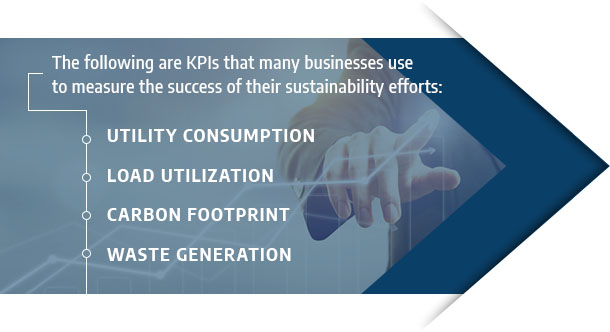
You probably use KPIs to evaluate many other aspects of your business, so make sure that you’ve also chosen a robust and useful set of indicators for sustainability. The following are some of the KPIs that many businesses use to measure the success of their sustainability efforts:- Utility Consumption: If reducing resource use is a priority in your sustainability strategy, utility consumption can be a great metric to observe.
- Load Utilization: This one can tell you a great deal about the efficiency of your supply chain. Trucks that frequently underutilize their load capacity are giving a sign that you may need to tweak your logistics strategies.
- Carbon Footprint: Reducing carbon emissions is a key strategy for fighting climate change, so it’s important to keep an eye on your emissions levels. A business’s “carbon footprint” is a holistic assessment of its carbon output based on a variety of factors, so it’s a good KPI to track.
- Waste Generation: Almost all businesses create waste of some kind, and reducing that waste is one of the most important ways to improve sustainability. Manufacturers likely already track materials waste, but other businesses may need to put some work into identifying exactly where their waste comes from, where it goes and how much of it they’re generating.
Note that all of these are big-picture statistics, and most can be broken down much further to more precisely identify areas for improvement. If you don’t have a robust reporting infrastructure in place to capture your most important sustainability KPIs, you’ll probably want to look into getting a system that will allow you to gather data on whether your efforts are producing results.
Analyze your logistics infrastructure for opportunities to eliminate waste.
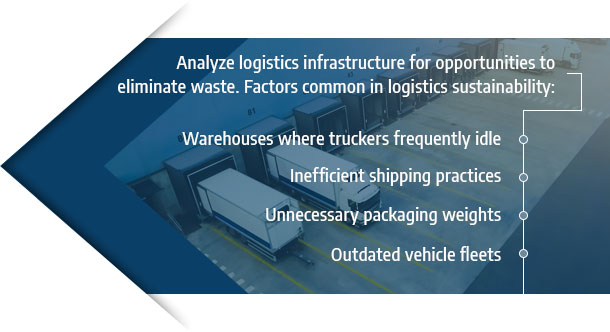
The logistics infrastructure of transportation and distribution is a key area of focus for many businesses seeking to improve their sustainability. With thousands of transportation vehicles on the roads every day, it’s more important than ever to make sure that supply chains are optimized for both sustainability and efficiency. Some of the factors commonly addressed in logistics sustainability include:- Warehouses where truckers frequently have to idle.
- Inefficient shipping practices resulting in more and longer trucking runs than necessary.
- Unnecessary packaging that weighs down transit vehicles, resulting in greater fuel costs.
- Outdated vehicle fleets that aren’t fuel-efficient.
- Routes that require drivers to spend a long time stuck in traffic.
Research and develop more sustainable packaging solutions.
Packaging waste is a huge source of pollution and contributes to the well-documented issues with garbage in oceans, rivers and lakes. Not only that—using extra packaging that you don’t need can be bad for the bottom line—it can mean higher fuel costs and money wasted on packaging that doesn’t get used. Air Sea Containers is proud to be a leading supplier of eco-friendly packaging for both hazmat and non-hazmat shippers all around the world. Our eco-friendly packaging solutions are designed as cleaner, less wasteful packaging that doesn’t compromise in providing top-flight protection for your goods, whether they’re being shipped by land, sea or air.
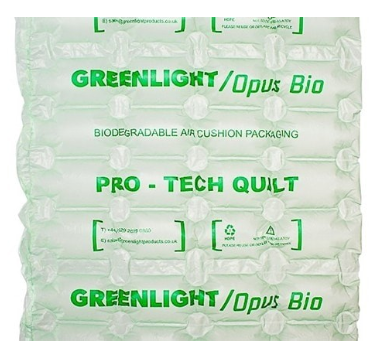
Opus Pro-Tech Quilt Inflatable Air Pillow / Cushion- Roll
To get you started on ideas for more eco-friendly packaging, here are some of Air Sea’s most popular green packaging materials:- Opus Biodegradable Air Pillows: These air pillows are perfect for void-fill applications to protect items from impact during transit and, unlike traditional air pillows, they’re made from 100 percent biodegradable plastic that leaves behind no traces of toxic heavy metals when it breaks down. They’re available in both standard and super-strength materials and in multiple sizes, so you can choose the ideal specifications for your needs. We’ve also got a full range of accessories, including hoppers and inflators so that your business can deploy these air pillows quickly and at scale.
- Eco-Friendly Refrigerant Gel Packs: Say goodbye to toxic and tricky-to-handle dry ice and gel packs that don’t really keep products cold. These refrigerant gel packs are created using an eco-friendly, non-toxic refrigerant, and they’re 100 percent recyclable and reusable. Many freight carriers also won’t ship dry ice or will charge substantially more to handle it—meaning that these gel packs also present an opportunity for significant cost savings.
- Biodegradable Sealed Air Peanuts: Packing peanuts are widely considered a less environmentally friendly material, but these peanuts are a whole new breed! They’re completely recyclable and biodegradable, and, what’s more, they even outperform normal Styrofoam peanuts in performance tests.
- Air-Lock Truck Dunnage Air Bags: These are another great example of how Air Sea products offer both better sustainability and better performance. Our Air-Lock Dunnage Air Bags are designed to prevent your products shifting in transit, and they’re made from a transparent polymer film that’s lighter and easier to work with than competing materials. This material is also more stretchable and durable, giving them an increased ability to handle pressure changes. Their unique construction also means that they’re both recyclable and reusable, making them the perfect choice for the eco-conscious freight shipper.
Another great option for more efficient, cost-effective, and sustainable packaging is to design your own custom corrugated shipping boxes. Air Sea Containers offers robust custom box creation services, including hazmat-rated boxes, multiple box styles and custom printing. By designing your own boxes that use only as much corrugated board as your products need, your business can potentially realize substantial savings from improved fuel costs and shipping efficiency.
Finally, Air Sea also offers great deals on some refurbished shipping materials. These include used drums in plastic or steel, used shipping containers, and more. Reuse-focused solutions like these help reduce the number of shipping materials that are used once and discarded, and they offer a great opportunity for targeted cost reductions.
Communicate transparently about your sustainability efforts.
Sustainability is always a team effort, so it’s important to keep up a running dialogue about sustainability all up and down your supply chain. Any time you begin a transition to a more sustainable business practice, you should make sure that your partners and suppliers know that the changes are a part of your sustainability strategy and that you’re committed to investigating further opportunities for sustainable commerce. You might be surprised at ways in which the other elements of your supply chain may be able to provide help. It’s also important to make your customers part of your sustainability dialogue, whether you’re a B2B or B2C business. If price increases are a necessary consequence of your sustainability strategy (and they sometimes are), be sure that your customers know that the increases are part of your transition to more sustainable commerce. As we mentioned before, customers are often willing to pay more for sustainably produced goods.
Sustainability isn’t always easy, and the process of becoming more sustainable comes with growing pains for almost every business, but it’s important to keep your eyes on the prize: a healthier business that’s better equipped to take on the challenges of a world where businesses must work side-by-side with nature and with each other.
It’s something that most businesses need some time to grow into and, as a leader in sustainable packaging, Air Sea Containers is proud to help. For more information on our many eco-friendly packaging solutions, give us a call at (866) 596-9448 or contact us online. We’ll be glad to help you discover the many ways that you can start transitioning to greener packaging and shipping materials. 


