A Step-by-Step Guide to Efficiently Organizing Your Warehouse
- By Cory Levins
- 5 mar 2020

Day in and day out, the warehouse is where the action is. It’s where shipments are received, customer orders are pulled, packed and shipped and inventory is monitored. On top of that, many warehouses perform additional tasks like product packaging. Clearly, many of a business’s most essential functions flow through the warehouse, so it’s important that the warehouse operates as smoothly as possible.
A warehouse’s procedures improve when a business takes care to apply its big-picture strategies to warehouse operations and takes a proactive approach to making improvements. A well-run warehouse can create big gains in productivity for your business, but it requires taking an in-depth look at your goals for the facility and willingness to invest time and resources in improvements.
Fortunately, warehouse optimization is something that any business can do, no matter its size. In this guide from Air Sea Containers, we’ll show you a simple and efficient warehouse optimization framework that can work for a wide variety of businesses and organizational strategies.

First, you need to be able to see the big picture. Get a complete warehouse floor plan and look at how it’s organized. Categorize each area by its function (such as shipping, packing, receiving or storage) and look at how foot or forklift traffic from each area flows (or does not flow) into the other areas. Take note of how an employee’s route through the warehouse varies depending on their duties and identify the areas where traffic clusters the most. What are the spots where hang-ups and delays occur, and how might that traffic be best redirected?
Finally, take note of hazardous materials present in your warehouse and include them on your floor plan. Many restrictions govern safe hazardous materials storage, so examine which types of products are stored in which areas and make sure they’re in compliance with the safety rules on each item’s MSDS. Incorporate these hazmat requirements as you move forward with your warehouse planning and reorganization.
There’s no substitute for experience on the ground, so visit the warehouse floor and spend some time walking from one area to another. Pretend you’re pulling an order, or packing one, or receiving a shipment. Which operations are slow, awkward or inefficient? How can the layout and organization be improved?
Make sure to get direct feedback on organizational strategies from your warehouse employees and supervisors. Their input will be critical to understanding the actual impact of a warehouse reorganization, as they’re often familiar with the little details that can make all the difference in optimizing a warehouse layout. Only the combined perspectives of the manager and the employee can create a system that works on every level.

During this process, take the time to build working relationships with warehouse employees. This will allow you to keep your ear to the ground on the operational state of the warehouse. When employees trust their managers and know that they can come to management with problems, the reward is a much more reliable picture of how things are running in the warehouse day-to-day.
High-quality and well-organized shelving makes a warehouse better and more efficient. If a warehouse is a body, then the shelving is its skeleton—the firm structure that holds everything in place.
Different types of containers and goods demand different storage equipment. Storage of steel shipping drums or polyethylene shipping drums will often require equipment like shipping drum caddies, while containers such as IBC totes are usually organized in pallet racking systems. A warehouse that specializes in non-pallet goods such as auto or electronics parts, meanwhile, might need color-coded storage bins that make it easy for pickers to find exactly what they need.
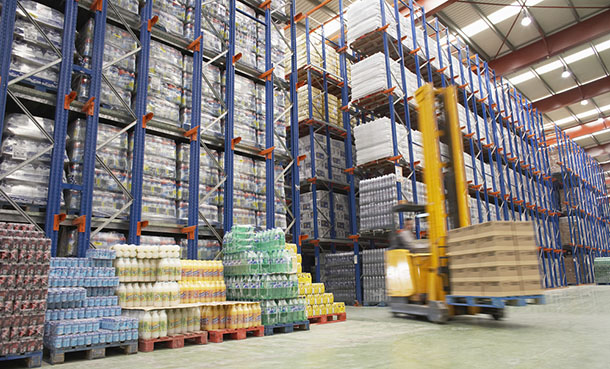
Pallet racking systems are one of the most common warehouse shelving systems, thanks to their ability to store large amounts of goods with a small footprint. They’re also highly versatile, with adjustable shelving and other features that allow them to accommodate a variety of item shapes and sizes. However, a pallet racking system requires the use of forklifts, making them impractical for warehouses that can’t easily accommodate forklift travel.
Make sure that the shelving system you choose is compatible with your plans for vertical storage. Some types of shelving can be built higher than others, so check the manufacturer’s specifications. The specifications should also list the shelves’ maximum weight rating, which is another factor to pay close attention to when designing shelving systems.
Hazardous materials will also affect your choice of shelving and storage. Some may require flammable safety storage cabinets to be stored safely, while others will need spill control pallets to guard against leaks. Consult your warehouse’s safety experts and make sure you’ve thoroughly identified each material’s specific safety challenges.
Browse Our Safety and Storage Cabinets
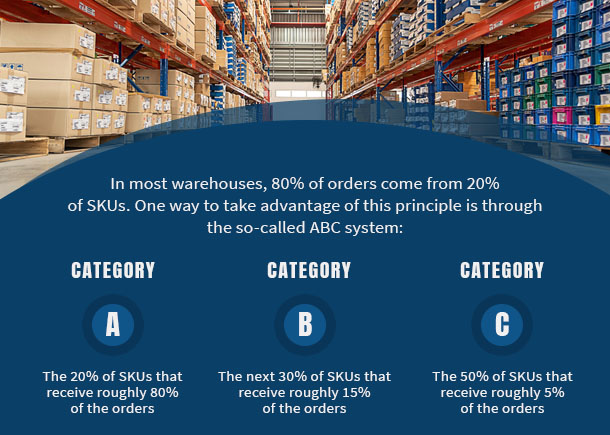
The nitty-gritty work of organization can be broken down into a couple of elements. First, remember the 80/20 rule. In most warehouses, 80 percent of orders come from 20 percent of SKUs. One way to take advantage of this principle is through the so-called ABC system:
Category A should be the most easily accessible to pickers, Category B the second-most accessible and Category C the third-most. It’s an easy way to improve productivity by reducing pick times and making employees’ jobs easier.
Next, give some thought to labeling strategies, as a robust labeling and tracking system is also important for a functional warehouse inventory. Many of today’s warehouses don’t have traditional labeling but use “pick to light” or “pick to voice” systems that use lighted displays or audio instructions to direct pickers to their next destination. Others use RFID tags that allow instant scanning with handheld RFID scanners.
Labeling can go beyond your inventory as well. Everything from forklift parking zones to equipment hooks can be labeled, creating a system with a correct place for everything. Don’t be afraid to add reminder notes to address persistent problems that have been targeted for improvement.
Finally, hazardous materials should be labeled using the appropriate UN hazmat labels. Not only are these labels often required by law, they’re also a vital part of maintaining a safe environment in which employees always know what they’re dealing with. Tough peel-and-stick vinyl hazmat labels from Air Sea Containers are an ideal choice.
Receiving and put-away are common problem areas for warehouse efficiency. When goods aren’t received, inventoried and stocked efficiently, many other areas (such as order fulfillment time and inventory accuracy) are also likely to suffer.
Problems in receiving can often be addressed by making sure that your warehouse’s receiving department has adequate space and equipment. Warehouse equipment like a shipping drum caddy makes bulky goods much easier to move, while reorganizing the receiving area can create an improved workflow.
Take note of the paths that flow out of receiving and into storage areas. Since receiving requires dock access, receiving stations have a relatively fixed location that’s rarely far away from the dock. Thus, when evaluating warehouse organization strategies, treat the receiving station as an anchor point and map out different potential warehouse configurations around it, considering how each one might help or hinder employees.
Warehouse organization is a process of constantly refining and improving your strategies, and one of the biggest keys to success is to optimize your space utilization. Vertical space utilization is especially important in warehouses, since horizontal space expansion often involves major investments such as remodeling a warehouse or purchasing additional land.
Some common ways to maximize warehouse space include:
All systems need to be maintained so that they stay fit for purpose. A warehouse organization system needs procedures in place that will help employees maintain it consistently and keep it functioning correctly.
In order for maintenance procedures to be applied consistently and correctly, your warehouse needs a good training process. Make sure that floor managers understand the system inside and out so that they can teach it more efficiently to employees and answer questions that pop up. If your warehouse uses technologies such as warehouse management systems or RFID scanners, take advantage of training resources offered by the manufacturers.

The importance of labeling is again apparent here, because labeling also comes in handy for maintaining a warehouse system. When everything has a proper place labeled, and every employee knows where the proper place is, employees have no good excuse to leave tools lying around or otherwise clutter the warehouse.
Speaking of clutter, don’t forget the importance of having clear and consistent waste disposal procedures. Every warehouse should have procedures in place for disposing of excess packaging, damaged products and general warehouse waste. Waste should be immediately disposed of in the proper receptacles, and the warehouse should have a schedule for emptying receptacles in a timely manner. Hazmat waste should be placed in the correct UN-compliant hazardous waste packaging and disposed of according to the correct protocols.
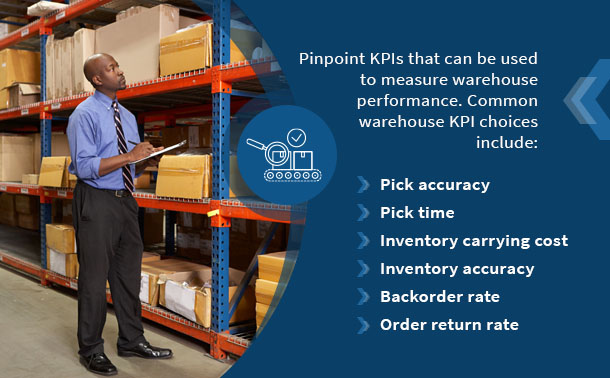
Regular auditing of your warehouse procedures will keep employees and management alike from becoming complacent. First, pinpoint some KPIs that can be used to measure warehouse performance. Common warehouse KPI choices include:
If possible, begin tracking your KPIs of choice before implementing a new system so that you can tell whether the new procedures are having a positive, negative or no impact. Give a new system at least a few months of data collection before making a final evaluation, and examine your warehouse data collection practices to ensure that your data are accurate and representative.
It’s also important to spend some time on the floor observing warehouse employees using the new system. Does it create synergy where it’s designed to? Are there unintentional problems that it creates in the process? Even the best-organized warehouses often need tweaking and tuning, so don’t be afraid to problem-solve aggressively—just make sure your employees have input on the solutions.
A well-organized warehouse creates efficiency and synergy that can spread its positive effects across an entire organization. At Air Sea Containers, we understand the importance of organization, so we offer a wide selection of warehouse organization tools–from drum storage to flammable safety cabinets–at prices that make the best solutions affordable. To learn more, call (866) 596-9448 or contact us online.
Request a Shipping Container Quote Now!
A warehouse’s procedures improve when a business takes care to apply its big-picture strategies to warehouse operations and takes a proactive approach to making improvements. A well-run warehouse can create big gains in productivity for your business, but it requires taking an in-depth look at your goals for the facility and willingness to invest time and resources in improvements.
Fortunately, warehouse optimization is something that any business can do, no matter its size. In this guide from Air Sea Containers, we’ll show you a simple and efficient warehouse optimization framework that can work for a wide variety of businesses and organizational strategies.
1. Analyze your floor plan.
First, you need to be able to see the big picture. Get a complete warehouse floor plan and look at how it’s organized. Categorize each area by its function (such as shipping, packing, receiving or storage) and look at how foot or forklift traffic from each area flows (or does not flow) into the other areas. Take note of how an employee’s route through the warehouse varies depending on their duties and identify the areas where traffic clusters the most. What are the spots where hang-ups and delays occur, and how might that traffic be best redirected?
Finally, take note of hazardous materials present in your warehouse and include them on your floor plan. Many restrictions govern safe hazardous materials storage, so examine which types of products are stored in which areas and make sure they’re in compliance with the safety rules on each item’s MSDS. Incorporate these hazmat requirements as you move forward with your warehouse planning and reorganization.
2. See the warehouse through an employee’s eyes.
There’s no substitute for experience on the ground, so visit the warehouse floor and spend some time walking from one area to another. Pretend you’re pulling an order, or packing one, or receiving a shipment. Which operations are slow, awkward or inefficient? How can the layout and organization be improved?
Make sure to get direct feedback on organizational strategies from your warehouse employees and supervisors. Their input will be critical to understanding the actual impact of a warehouse reorganization, as they’re often familiar with the little details that can make all the difference in optimizing a warehouse layout. Only the combined perspectives of the manager and the employee can create a system that works on every level.
During this process, take the time to build working relationships with warehouse employees. This will allow you to keep your ear to the ground on the operational state of the warehouse. When employees trust their managers and know that they can come to management with problems, the reward is a much more reliable picture of how things are running in the warehouse day-to-day.
3. Get your shelving squared away.
High-quality and well-organized shelving makes a warehouse better and more efficient. If a warehouse is a body, then the shelving is its skeleton—the firm structure that holds everything in place.
Different types of containers and goods demand different storage equipment. Storage of steel shipping drums or polyethylene shipping drums will often require equipment like shipping drum caddies, while containers such as IBC totes are usually organized in pallet racking systems. A warehouse that specializes in non-pallet goods such as auto or electronics parts, meanwhile, might need color-coded storage bins that make it easy for pickers to find exactly what they need.
Pallet racking systems are one of the most common warehouse shelving systems, thanks to their ability to store large amounts of goods with a small footprint. They’re also highly versatile, with adjustable shelving and other features that allow them to accommodate a variety of item shapes and sizes. However, a pallet racking system requires the use of forklifts, making them impractical for warehouses that can’t easily accommodate forklift travel.
Make sure that the shelving system you choose is compatible with your plans for vertical storage. Some types of shelving can be built higher than others, so check the manufacturer’s specifications. The specifications should also list the shelves’ maximum weight rating, which is another factor to pay close attention to when designing shelving systems.
Hazardous materials will also affect your choice of shelving and storage. Some may require flammable safety storage cabinets to be stored safely, while others will need spill control pallets to guard against leaks. Consult your warehouse’s safety experts and make sure you’ve thoroughly identified each material’s specific safety challenges.
Browse Our Safety and Storage Cabinets
4. Organize and label.
The nitty-gritty work of organization can be broken down into a couple of elements. First, remember the 80/20 rule. In most warehouses, 80 percent of orders come from 20 percent of SKUs. One way to take advantage of this principle is through the so-called ABC system:
- Category A: The 20 percent of SKUs that receive roughly 80 percent of the orders.
- Category B: The next 30 percent of SKUs that receive roughly 15 percent of the orders.
- Category C: The 50 percent of SKUs that receive roughly 5 percent of the orders.
Category A should be the most easily accessible to pickers, Category B the second-most accessible and Category C the third-most. It’s an easy way to improve productivity by reducing pick times and making employees’ jobs easier.
Next, give some thought to labeling strategies, as a robust labeling and tracking system is also important for a functional warehouse inventory. Many of today’s warehouses don’t have traditional labeling but use “pick to light” or “pick to voice” systems that use lighted displays or audio instructions to direct pickers to their next destination. Others use RFID tags that allow instant scanning with handheld RFID scanners.
Labeling can go beyond your inventory as well. Everything from forklift parking zones to equipment hooks can be labeled, creating a system with a correct place for everything. Don’t be afraid to add reminder notes to address persistent problems that have been targeted for improvement.
Finally, hazardous materials should be labeled using the appropriate UN hazmat labels. Not only are these labels often required by law, they’re also a vital part of maintaining a safe environment in which employees always know what they’re dealing with. Tough peel-and-stick vinyl hazmat labels from Air Sea Containers are an ideal choice.
5. Get your receiving in shape.
Receiving and put-away are common problem areas for warehouse efficiency. When goods aren’t received, inventoried and stocked efficiently, many other areas (such as order fulfillment time and inventory accuracy) are also likely to suffer.
Problems in receiving can often be addressed by making sure that your warehouse’s receiving department has adequate space and equipment. Warehouse equipment like a shipping drum caddy makes bulky goods much easier to move, while reorganizing the receiving area can create an improved workflow.
Take note of the paths that flow out of receiving and into storage areas. Since receiving requires dock access, receiving stations have a relatively fixed location that’s rarely far away from the dock. Thus, when evaluating warehouse organization strategies, treat the receiving station as an anchor point and map out different potential warehouse configurations around it, considering how each one might help or hinder employees.
6. Do more with your space.
Warehouse organization is a process of constantly refining and improving your strategies, and one of the biggest keys to success is to optimize your space utilization. Vertical space utilization is especially important in warehouses, since horizontal space expansion often involves major investments such as remodeling a warehouse or purchasing additional land.
Some common ways to maximize warehouse space include:
- Increasing the vertical height of storage racks. This is a common option and a relatively simple way to improve storage capacity, but as previously mentioned, it’s important not to build racks higher than the manufacturer’s specifications or to overload their weight rating.
- Making warehouse aisles narrower, creating space savings that add up to enough room for one or more new aisles. Just make sure that the aisles are still wide enough for forklifts, pallet jacks and any other equipment your warehouse uses.
- Adding a row of mezzanine storage as a second “floor” above the warehouse’s current storage space. This option can be pricey, but it’s almost always less costly than expanding the warehouse itself, making mezzanine storage a solid medium- to long-term solution. For facilities where a full-sized mezzanine doesn’t make sense, many warehouses install racks over the dock area or “tunnel” some aisles with overhead racks.
- Clearing out “dead” inventory that’s obsolete, damaged or otherwise unsellable. Many warehouses have items taking up rack space that should have gone to the dumpster long ago. Establish standards for which inventory should be discarded or sent to a different facility and then run a warehouse-wide inventory audit to identify and remove dead inventory.
- Examining demand forecasting data to identify areas where your forecasting model is performing well or poorly. If backorders are a consistent problem, reach out to your analytics team and discuss how to improve forecasting for the warehouse. The more accurate your model is, the easier it will be to utilize warehouse space effectively.
7. Develop maintenance procedures.
All systems need to be maintained so that they stay fit for purpose. A warehouse organization system needs procedures in place that will help employees maintain it consistently and keep it functioning correctly.
In order for maintenance procedures to be applied consistently and correctly, your warehouse needs a good training process. Make sure that floor managers understand the system inside and out so that they can teach it more efficiently to employees and answer questions that pop up. If your warehouse uses technologies such as warehouse management systems or RFID scanners, take advantage of training resources offered by the manufacturers.
The importance of labeling is again apparent here, because labeling also comes in handy for maintaining a warehouse system. When everything has a proper place labeled, and every employee knows where the proper place is, employees have no good excuse to leave tools lying around or otherwise clutter the warehouse.
Speaking of clutter, don’t forget the importance of having clear and consistent waste disposal procedures. Every warehouse should have procedures in place for disposing of excess packaging, damaged products and general warehouse waste. Waste should be immediately disposed of in the proper receptacles, and the warehouse should have a schedule for emptying receptacles in a timely manner. Hazmat waste should be placed in the correct UN-compliant hazardous waste packaging and disposed of according to the correct protocols.
8. Audit and review.
Regular auditing of your warehouse procedures will keep employees and management alike from becoming complacent. First, pinpoint some KPIs that can be used to measure warehouse performance. Common warehouse KPI choices include:
- Pick accuracy
- Pick time
- Inventory carrying cost
- Inventory accuracy
- Backorder rate
- Order return rate
If possible, begin tracking your KPIs of choice before implementing a new system so that you can tell whether the new procedures are having a positive, negative or no impact. Give a new system at least a few months of data collection before making a final evaluation, and examine your warehouse data collection practices to ensure that your data are accurate and representative.
It’s also important to spend some time on the floor observing warehouse employees using the new system. Does it create synergy where it’s designed to? Are there unintentional problems that it creates in the process? Even the best-organized warehouses often need tweaking and tuning, so don’t be afraid to problem-solve aggressively—just make sure your employees have input on the solutions.
A well-organized warehouse creates efficiency and synergy that can spread its positive effects across an entire organization. At Air Sea Containers, we understand the importance of organization, so we offer a wide selection of warehouse organization tools–from drum storage to flammable safety cabinets–at prices that make the best solutions affordable. To learn more, call (866) 596-9448 or contact us online.
Request a Shipping Container Quote Now!