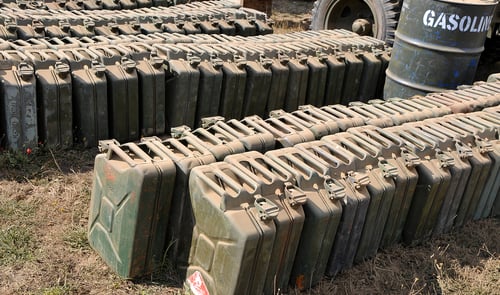
The turning point of the technological tug-of-war in World War II centered on a product the Allied Forces initially overlooked, a product Hitler secretly stockpiled in anticipation of war: the jerrican.
A jerrican or jerry can is a container used for efficient fuel transportation. Its success during World War II enabled the Germans to employ their famous Blitzkrieg strategy and overrun most of Europe in record time.
More than half a century later, jerricans still provide the safest means of securely transporting both hazardous and non-hazardous liquids, and even remain in compliance with rules and regulations developed since the war such as regulations associated with the International Air Transport Association (IATA) and International Maritime Dangerous Goods (IMDG) Code.
Initial German design
On the brink of World War II, the Germans correctly understood the varying fuel demands of heavy combat and rapid movement in mechanized warfare. Consequently, they devised their high-speed Blitzkrieg strategy to employ what they called the “Wehrmacht-Einheitskanister” (“armed forces unit canister”). This humble container allowed the Germans to extend their supply lines and outmaneuver the Allied forces.
The Allies called the cans the “jerry cans,” as “jerry” was slang at the time for Germans.
The jerrican provided a few essential advantages over previous fuel transport containers:
- Its small spout enabled fuel to be poured without the need of a funnel, opener, or extra tools. This allowed quick and efficient refueling under combat conditions and reduced spillage.
- A gasket built onto the container rendered the mouth effectively leak-proof.
- Perhaps most importantly, an impermeable plastic casing lined the inside of every jerrican to prevent leakage and preserve the can.
These modifications, along with a few others, minimized fuel loss and expedited transportation.
The vacation that brought the jerrican to U.S. soil:
In the summer of 1939, an American engineer named Paul Pleiss intended to join a German colleague on a road trip across Europe and on to India. The two needed a means to travel with an emergency water supply, prompting the German engineer to covertly retrieve three jerricans from the Tempelhof Airport and mount them underneath their car.
Remarkably, their journey led them through 11 countries without any incident. Then, halfway through India, Field Marshal Goering needed the German engineer’s expertise and Paul’s friend had to fly home.
With war brewing, Pleiss recognized he possessed something that could greatly benefit the Allied war effort. Pleiss put the car into storage and quickly boarded a flight for the U.S. However, when he informed military officials of the container’s efficacy, the lack of a sample garnered minimal interest for the design.
Because Pleiss desperately needed a sample but couldn’t risk shipping the jerricans alone, he made a courageous decision: He would ship his whole car from Calcutta. Unfortunately, when he eventually shipped a jerrican sample to Washington D.C., the War Department determined a revised WWI container would be sufficient.
British jerricans enter mass production:
In 1940, the British would be the first Allied country to identify the jerrican’s significance, stumbling upon the containers as a result of the German invasion of Norway. This prompted British officers to contact Pleiss when he visited London and request information on the jerrican’s design.
Pleiss urgently shipped one of his jerrican samples from the U.S. to London, where the British set about reverse-engineering an identical model. However, it wasn’t until 1942 that the jerricans entered mass production.
The Allied Forces initially requested the British manufacture all jerricans used in combat, but increased demand later forced the U.S. to enter into production also.
By 1944, jerricans moved over a million gallons of fuel per day to help advance Allied forces.
 Modern usage of jerricans:
Jerricans remain heavily utilized by the military, as army forces of NATO-affiliated countries continue to employ the WWII design for liquid transportation.
Additionally, because jerricans provide very secure vessels for potentially harmful liquids, the government and private industry use the containers to store increasingly more substances—particularly when transportation is necessary.
Corporations compelled to safeguard liquids during shipment and storage use jerricans due to the high degree of protection the containers provide. Many households use jerricans for the storage of chemicals and gasoline. Jerricans even assist those in regions of water scarcity by providing a tight container for water delivery.
Plastic:
Plastic high-density polyethylene (HDPE) jerricans ensure the same safety in transporting hazardous materials, while also providing a more cost-effective and lightweight option. High-density polyethylene produces an optimal container because it remains resistant to liquid absorption, even to such highly corrosive materials as acid and aldehydes.
As modern jerricans now transport a wider range of potentially hazardous liquids, it becomes important to verify contents without directly inspecting the liquid inside. To differentiate between various types of liquid contents, a color-coded system has also been implemented.
Recycling jerricans:
During World War II, an unbelievable 3.5 million jerricans were reported lost in October 1944 when military movements of troops and vehicles reached its peak.
This problem reached such epidemic proportions, the U.S. even offered rewards to French schoolchildren for the collection of empty, discarded jerricans. Approximately one million cans were recovered this way.
Today, jerrican manufacturers have made recycling the containers much easier, with many using sustainable, recyclable packaging. High-density polyethylene remains one of the easiest plastic polymers to recycle, and, if a jerrican is uncontaminated, it can be taken to the majority of recycling centers. If a jerrican has contained hazardous material, it can be taken to a household hazardous waste drop-off.
Final Thoughts
After WWII, President Franklin Roosevelt acknowledged the pivotal role jerricans played in an Allied victory, stating, “Without these cans it would have been impossible for our armies to cut their way across France at a lightning pace which exceeded the German Blitzkrieg of 1940.”
Such recognition pays serious tribute to the efficiency and safety of jerricans, hinting at the role these containers would play in transportation for decades to come.