
What You Need To Know About IMDG Code Amendment 36-12
- By Mike Bond
- 3 oct 2012
[caption id="attachment_70" align="alignright" width="211"]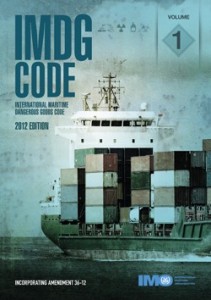 New IMDG Changes Coming October/November 2012[/caption]
The IMDG code 2012 amendment 36-12 comes into effect on 1 January 2013 if adopted by the national administration. It will become mandatory from 1 January 2014. The amendment comes with new UN numbers that go up to 3506 and new instructions about how packing should be done. There are also several detailed changes to the chapters and to the entries in the Dangerous Goods List. It is important for those in the sector to know what the changes are and what they will mean for business.
Part 7 of the Stowage and Segregation has been completely reorganized to suit job function. While 7.1 and 7.2 contains the rules for general stowage and segregation, chapter 7.3 has been revised to carry regulations about how goods should be loaded into a CTU.
Another change is with sources of heat. There has been a replacement of the regulations about various 'away' from all sources of heat shading from direct sunlight and radiant heat, flames and speaks. Instead there is a general rule that says that cargo has to be protected from sources of heat and the meaning of this is laid out in 7.1.2.
Some of the changes call for cargo being a minimum of 2.4 m away from ship structures that are heated. Also, cargo that is on deck but is not in CTUs has to shaded from direct sunlight. Also, depending on what is being shipped and on the route that will be taken, the exposure of CTUs on deck to direct sunlight may have to be reduced.
The rules have also changed when it comes to foodstuff. Regulations about segregation of foodstuff that is now referred to as 1.2.1 have been amended with the removal of the specifications 'away from' foodstuff and 'separated from' foodstuff.
A class or subrisk of 2.3, 6.1, 6.2, 7 and 8 and some particular DGL entries are not to be packed together with foodstuff in the same CTU. Provision has been made for some of the class 6.1 and 8 items and some particular DGL entries which can be shipped a CTU that is carrying food without having to get competent authority approval as long as a distance of at least 3m is maintained.
Another amendment is to class 6.2 which will now require where segregation from food but it will be to value 2 rather then 3 if a CTU is closed. Value 2 still applies to the other classes and to DGL specific goods but the value can be reduced to 1 if one of the items is a closed CTU. It can go up to O if both items are in closed containers. Lowering of the segregation value to 1 for class 8 and class 6.1 pg 111 has been done away with.
Another Imdg code 2012 amendment 36-12 is to the rules of limited quantities. When they are being shipped in limited quantities, rigid intermediate packaging must be done for liquids in glass that are in class 8 packing group 11 as well as those with similar inners. Other LQ substances that are in fragile liners will have to be put in appropriate intermediate packaging when they are in stretch-wrapped trays or in shrink wrapping.
Also, it will now be necessary to get a classification reference for UN 0333-7 fireworks from a competent authority. Stowage categories have been reduced to five and they are different from the current 01 to 05 categories.
Imdg code 2012 amendment 36-12 will mean changes in the cost of shipping so the rates charged to clients will have to be revised accordingly. This will ensure the bottom line is not negatively impacted.
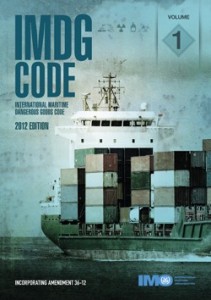 New IMDG Changes Coming October/November 2012[/caption]
The IMDG code 2012 amendment 36-12 comes into effect on 1 January 2013 if adopted by the national administration. It will become mandatory from 1 January 2014. The amendment comes with new UN numbers that go up to 3506 and new instructions about how packing should be done. There are also several detailed changes to the chapters and to the entries in the Dangerous Goods List. It is important for those in the sector to know what the changes are and what they will mean for business.
Part 7 of the Stowage and Segregation has been completely reorganized to suit job function. While 7.1 and 7.2 contains the rules for general stowage and segregation, chapter 7.3 has been revised to carry regulations about how goods should be loaded into a CTU.
Another change is with sources of heat. There has been a replacement of the regulations about various 'away' from all sources of heat shading from direct sunlight and radiant heat, flames and speaks. Instead there is a general rule that says that cargo has to be protected from sources of heat and the meaning of this is laid out in 7.1.2.
Some of the changes call for cargo being a minimum of 2.4 m away from ship structures that are heated. Also, cargo that is on deck but is not in CTUs has to shaded from direct sunlight. Also, depending on what is being shipped and on the route that will be taken, the exposure of CTUs on deck to direct sunlight may have to be reduced.
The rules have also changed when it comes to foodstuff. Regulations about segregation of foodstuff that is now referred to as 1.2.1 have been amended with the removal of the specifications 'away from' foodstuff and 'separated from' foodstuff.
A class or subrisk of 2.3, 6.1, 6.2, 7 and 8 and some particular DGL entries are not to be packed together with foodstuff in the same CTU. Provision has been made for some of the class 6.1 and 8 items and some particular DGL entries which can be shipped a CTU that is carrying food without having to get competent authority approval as long as a distance of at least 3m is maintained.
Another amendment is to class 6.2 which will now require where segregation from food but it will be to value 2 rather then 3 if a CTU is closed. Value 2 still applies to the other classes and to DGL specific goods but the value can be reduced to 1 if one of the items is a closed CTU. It can go up to O if both items are in closed containers. Lowering of the segregation value to 1 for class 8 and class 6.1 pg 111 has been done away with.
Another Imdg code 2012 amendment 36-12 is to the rules of limited quantities. When they are being shipped in limited quantities, rigid intermediate packaging must be done for liquids in glass that are in class 8 packing group 11 as well as those with similar inners. Other LQ substances that are in fragile liners will have to be put in appropriate intermediate packaging when they are in stretch-wrapped trays or in shrink wrapping.
Also, it will now be necessary to get a classification reference for UN 0333-7 fireworks from a competent authority. Stowage categories have been reduced to five and they are different from the current 01 to 05 categories.
Imdg code 2012 amendment 36-12 will mean changes in the cost of shipping so the rates charged to clients will have to be revised accordingly. This will ensure the bottom line is not negatively impacted.


