What Can Small Businesses Learn from the Amazon Giant?
- By Cory Levins
- 10 abr 2018

Small businesses have much to learn from the most successful online retailer in the history of e-commerce, Amazon. Their success can be attributed to good decision-making in the most common functional areas of a business including sales, marketing, finance and accounting, customer service, human resources, research and development and distribution. However, it all starts with the customer.
Customer Service
“To be Earth’s most customer-centric company, where customers can find and discover anything they might want to buy online.” As stated in the Amazon vision statement, their goal is to become the best e-commerce company in the world. Clearly, they have achieved that goal and done so in large part by offering the best customer service available online. The American Customer Satisfaction Index shows Amazon as the irrefutable leader among Internet retailers and overall customer satisfaction.
The relentless pursuit of a customer-centric approach across all company departments and the unyielding philosophy of serving the customer by Jeff Bezos, Amazon’s founder and CEO, has catapulted Amazon to the number one position. The most recent statistics show, according to Statista, the Statistics Portal, Amazon had 310 million active customers in 2016.

Small businesses, while facing some economic and physical limitations on implementing Amazon warehousing techniques, have very few restrictions copying Amazon’s customer service philosophy. Here are some features of the Amazon program that have contributed to its success.
Listen to Your Customers and Understand Them
Talking to customers is one thing, but listening and understanding their needs is mandatory to reach a solution to any issue with total customer satisfaction. Amazon feels that understanding the customer is not limited to the Customer Service department, but every Amazon employee whether entry-level or executive must appreciate customer requirements.
Every year, Jeff Bezos requires Amazon managers to attend two days of call-center training. Bezos attends the sessions as well. The purpose is for all employees to learn how to listen, not only talk to customers, and to emphasize Amazon’s philosophy of understanding customer needs.
Serve the Needs of the Customer
Henry Ford once said, “It’s not the employer who pays the wages. Employers only handle the money. It’s the customer who pays the wages.” A successful company will determine what the customers need and work to serve them.
Jeff Bezos’ philosophy: “We’re not competitor obsessed, we’re customer obsessed. We start with what the customer needs and we work backwards.” He demonstrated his commitment to his unrelenting design and development of the Kindle tablet. While some engineers expressed their personal preferences that differed, customer requirements defined its form and functionality. Although it took years to construct the right hardware, Bezos never faltered in creating a product built for the customer.
Just four years after the introduction of Kindle, sales were growing so fast they became a driver of Amazon’s overall growth.
Bezos had a simple and very straightforward explanation: Kindle success comes from… “the best purpose-built e-reader, the best e-bookstore, and the best ecosystem, so you can read where you want to…It seems like what our customers would want.”
All of Amazon’s departments are entirely data-driven based on the success and failure of the customer experience. This concrete performance evidence allows Bezos to take risks, innovate and make difficult decisions based on what is best for the customer and in the end, what is best for the company.
For the small business evaluating a product or service offering, rather than thinking about how to make the product or organization better, a focus on how to make the customers more successful will most likely be more productive.

Analyze, Understand and Interpret Customer Complaints
Customer service at Amazon permeates the entire company. Even during the early days of Amazon, Bezos’ priorities stressed the philosophy of a company obsessed with their customers from top to bottom. To demonstrate, Bezos brought an empty chair into the room when he met with top company executives and asked them to consider, during all discussions, the seat to be occupied by their customer, “the most important person in the room.” The impact was decision-making based on a clear accounting of customer needs.
While an empty chair in meetings may not be necessary for the small business, the same consideration for the customer, no matter what their complaints, may be applied to the way customers are served today.
The first step for exceptional customer service is to acknowledge the complaint. This simple act allows the customers to feel at ease as if the customer service representative is on their side. Dealing with a company that is unwilling to admit that a mistake has even occurred makes resolution impossible. In today’s business environment, long phone holds, slow follow-up communications and discourteous or obstinate customer service representatives have become commonplace. Frequently, consumer complaints are not even registered for fear of adverse customer treatment and a consequential pessimistic attitude toward issue resolution.
As a result, dissatisfied customers are reluctant to try the company a second time. These former customers are likely to spread negative feedback about the company and its brand and the opportunity to convert a one-time purchase into a loyal return buyer is lost.
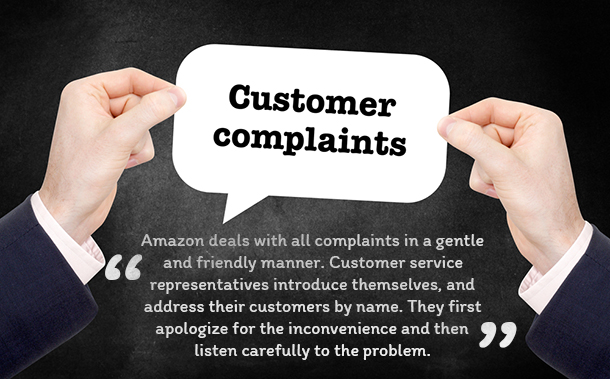
Amazon customer service deals with all complaints in a gentle and friendly manner. Customer service representatives introduce themselves, and they address their customers by name. They first apologize for the inconvenience and then listen carefully to the problem. But more than that, they strive to understand completely the nature of the complaint and the distress the issue has caused the customer. Their sympathetic character and the sincere determination to resolve an issue to a consumer's complete satisfaction is what sets Amazon customer service representatives apart.
Recommendations for the Small Business:
- Maintain modesty and remain polite throughout the process. Personalize the experience by addressing customers by name.
- Sympathize and endeavor to relate to the customer's feelings.
- Treat customers like people and consider their problem the most important issue of the day.
These techniques will help reach the best solution, which may be unique for each customer. Stay on track and remember what is important!
Never Settle for 99%
Back in December 2011, Jeff Bezos promised to fulfill holiday orders by delivering packages to 99.9% of Amazon’s customers before Christmas. He reached his goal, delivering millions of packages around the world, only falling short by a handful of deliveries. However, Bezos was less than satisfied. He commented, “We’re not satisfied until it’s 100%,” clearly indicating there was room for improvement.
The same goals should be applied to customer service. Response time and satisfaction ratings should never be considered sufficient at 99%, and efforts to achieve 100% should be unwavering. In today’s digital age, communications are fast and widespread. Customers talk to one another and companies that provide a satisfactory customer experience get referrals. So important is the consumer experience, customers are willing to pay higher prices if assured that issues will be resolved should they arise.
Customer Respect
For the brick and mortar business of yesteryear, an unhappy customer may have told several friends and therefore had minimal impact on business operations. If Internet customers are unsatisfied, they can reach thousands, and the effects can be devastating.

Today’s customer is listening to peers, has access to a wealth of research material online and is not reluctant to post complaints on social media. Customer relationships with business owners are entirely different in the digital age than they once were without the Internet. Jeff Bezos became a successful e-commerce pioneer because he understood early on the authority today’s customer possesses with Internet tools.
Small business owners today must use the same tools to research and fully understand their customer base, not ever taking them for granted. Brands that were once considered superior and highly respected have suffered solely due to mishandled situations with an unhappy customer.
While bad reviews and complaints from customers are a part of every business, owners need to have a clear and concise plan to deal with them. Even for the worst customer service nightmare, customer service representatives must never fail to respond promptly, always speak politely and never forget to say thank you.
Admit the Mistakes and Apologize
During the past 24 years of existence, Amazon has received and deserved an abundance of positive press due to their e-commerce innovations and outstanding customer service.
However, in 2009, the fundamental principles of the online book giant were shaken when Amazon discovered that illegal copies of George Orwell's two seminal novels, 1984 and Animal Farm, were being sold. Their solution was direct and abrupt, remotely deleting copies of the books from users’ Kindles. The incident provoked a protest from Kindle users and a general outcry of Internet users who questioned the power of Amazon and the apparent “Big Brother” image, one that Bezos sought to avoid. While Amazon quickly apologized for the incident in the usual press release fashion, it was an informal and heartfelt apology from Jeff Bezos that saved the Kindle customer base:
“This is an apology for the way we previously handled illegally sold copies of 1984 and other novels on Kindle. Our ‘solution’ to the problem was stupid, thoughtless, and painfully out of line with our principles. It is wholly self-inflicted, and we deserve the criticism we’ve received. We will use the scar tissue from this painful mistake to help make better decisions going forward, ones that match our mission.”

Sincerity, self-criticism and reconciliation were key to assuaging the potentially disastrous publicity. Bezos’ apology, admission of error and acceptance of total responsibility was met with praise, and the problem was quickly forgotten.
Amazon is the most powerful retailer online, and it has achieved that status by adhering to a customer-centric philosophy. For the small company that makes a mistake, placing blame on the delivery service or chalking it up to bad luck will never work. Admit responsibility and offer customers a sincere apology. They will usually respond by quickly offering their forgiveness.
Amazon Supply Chain Management
Amazon’s success as an e-commerce retailer can be attributed to multiple sets of marketing, sales and operations strategies. While customer service is a key, Amazon has been successful implementing bold supply chain strategies and innovative technologies with one simple goal: reduce package delivery time.
Rapid Growth
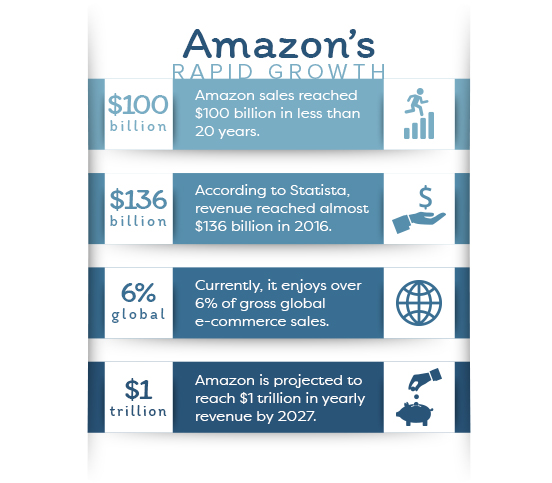
Amazon sales reached $100 billion in less than 20 years, faster than any other company and, according to Statista, revenue reached almost $136 billion in 2016. Currently, it enjoys over 6% of gross global e-commerce sales and is projected to reach $1 trillion in yearly revenue by 2027.
Whether Amazon reaches that goal or not, one key factor behind the colossal transformation from a simple online bookseller to arguably the most dominant entity in the retail industry is its technologically innovative and highly efficient supply chain.
Amazon’s relentless pursuit of faster package delivery times has caused intense pressure on other large competitive retailers worldwide and is changing the definition of supply chain management.
Delivery Strategy: Amazon Prime
Amazon’s introduction of Prime delivery service in 2005 put the company in a dominant position, well ahead of its closest competitor for speed of delivery. For an annual membership fee, customers received guaranteed two-day shipping on thousands of Amazon products.
The response from other retailers matching the strategy offering their own free two-day shipping was met by Amazon with Amazon Prime Now service, a one-hour delivery. Recently, it has improved on the delivery time by providing a free two-hour delivery for Amazon Prime Now subscribers.
Amazon’s Efficient Supply Chain Management Practices
Amazon’s efficient supply chain is the result of an extensive warehouse network, multi-tier inventory management, sophisticated information technology and exceptional transportation. With over 90,000 full-time employees and 70 fulfillment centers, many in proximity to local urban markets, Amazon has positioned itself to make good on increasingly fast delivery promises.

Warehouse Automation
Over the years, Amazon has significantly augmented its use of warehouse robots, growing at the rate of 15,000 per year since 2015. As of January 2017, Amazon had more than 45,000 warehouse robots. While previous robot automation was aimed at bringing goods to people for the picking of orders, the next generation of robots will be self-sufficient, picking the orders on their own to reduce the need for human interaction.
Effect on Competitors
Amazon’s supply chain management innovations have been implemented at a remarkable rate and have forced its major competitors to increase their investment in supply chain automation with the goal of reducing the product delivery time. While some of the changes may be reserved for only the largest online retailers, small and medium-sized companies can benefit by following Amazon’s lead, albeit on a much smaller scale.
Conclusion
Customer service and supply chain management, including warehousing, efficiency and product delivery times, all contribute to the success of an e-commerce business. Amazon has blazed the way with its implementation of innovative policies and advanced technology. Small business has a lot to gain by emulating Amazon's operations.