Understanding Cycle Time vs. Lead Time in Shipping
- By Cory Levins
- 22 nov 2021

Summary:
- Cycle time in shipping is the average time spent delivering a package, from the moment it leaves the sender to the point it reaches the customer.
- Cycle time is measured against Takt time, which is essentially a measure of customer demand. Cycle time must be equal to or higher than Takt time to meet demand.
- Lead time is cycle time plus time spent processing an order. It includes all tasks before the shipping process begins, such as item picking or packing.
- Cycle time is challenging to compress, as it depends on carriers. However, there are many ways to improve lead times.
Most people misunderstand the difference between cycle time and lead time, and some even use both terms interchangeably. However, each has a distinct definition, and it is critical not to confuse one for the other.
Although you primarily find cycle time and lead time applied in manufacturing and supply chain management, the same concepts and principles apply in the shipping industry. Understanding the difference between cycle time and lead time in shipping is essential to maximize delivery efficiency.
Cycle Time Explained
Each industry uses the term differently, leading to confusion and the lack of a consistent definition. For example, the meaning of cycle time in software development is vastly different from the definition used in manufacturing. In some contexts, cycle time is identical to lead time.
The simplest definition of cycle time is the amount of time required to complete a task. It includes any waiting periods between the start and the completion of this task, whether planned or unplanned.
- In manufacturing, cycle time equals the amount of time required to produce an item, from the start of the process to the moment it is ready for shipping.
- In shipping, cycle time is the amount of time it takes to ship an item to a customer, from the moment it leaves the sender to the day the customer receives it.

Calculating cycle time requires two values: the total number of tasks completed (N) and the total time needed to complete these tasks (T). Cycle time is equal to T divided by N.
Example Scenario: Cycle Time
Alpha Shipping Company operates 8 hours per day, 5 days per week. Every day, there is a total of 75 minutes spent on all breaks and other non-working periods. Out of the 40 nominal work hours per week, Alpha Shipping Company’s net production time is 33 hours and 45 minutes. So, Alpha’s T value is equal to 33.75.
Each week, Alpha ships approximately 4,500 custom shipping boxes. So, Alpha’s N value is equal to 4,500.
33.75 divided by 4,500 equals 0.0075. 0.0075 hours equals 27 seconds. So, Alpha Shipping Company’s cycle time is equal to 1 package every 27 seconds.
Takt Time: A Way to Calculate Performance
Cycle time is what the industry calls a Key Performance Indicator (KPI). In shipping, improving KPIs means improving the company’s ability to ship packages efficiently.
However, without a metric or an indicator to compare your cycle time with, you have no way of finding whether your current cycle time is competitive. Takt time is used to indicate whether your cycle time is competitive.
Etymology and Meaning
Takt time is the English transliteration of takuto taimu, a Japanese term that borrows from the German word Taktzeit.
Taktzeit is a composite of two German words: Takt (beat or interval) and Zeit (time). So, Taktzeit translates to “interval time.”
Takt time is the task completion rate required to meet a customer’s demands. In general, the Takt time is the target value for cycle time; the cycle time must be equal to or higher than the Takt time to meet demands.

Why Takt Time Is Critical
If the cycle time is significantly lower than the Takt time, task completion may be inefficient or take too long. However, if the cycle time is significantly higher than the Takt time, it may be a symptom of overproduction, and scaling back may be necessary.
The ideal cycle time should be equal to the Takt time. However, most companies aim for a cycle time slightly higher than the Takt time to account for unplanned situations, such as shipping delays or errors.
Takt time is calculated, not measured. If the net time spent working per shift is equal to T, and the rate of customer demand per shift is equal to D, then Takt time equals T divided by D.
Example Scenario: Takt Time
Alpha Shipping Company has calculated that their customer demand for lithium-ion battery packaging is approximately 1,200 units per day.
Knowing that Alpha is open 5 days of the week and its net operation time per week is 33 hours and 45 minutes, we can deduce the following:
- T equals 33.75 hours.
- With 5 working days per week, D equals 6,000 (1,200 units times 5 days).
33.75 divided by 6,000 equals 0.005625. 0.005625 hours equals 20.25 seconds.
So, Alpha Shipping Company’s Takt time is approximately 1 unit shipped every 20 seconds.
With a Takt time of 20.25 seconds, Alpha’s cycle time of 27 seconds is too slow to meet customer demand. The company must identify ways to improve its cycle time and eliminate delays when shipping lithium batteries.
Lead Time Defined
If cycle time measures the average amount of time required to complete a task, the lead time is the exact time it takes to complete an order.
Depending on the industry, there may be no difference between cycle time and lead time. However, this is not the case in the shipping industry, as there may be significant delays between the moment a shipping company receives an order and when the shipping process begins.
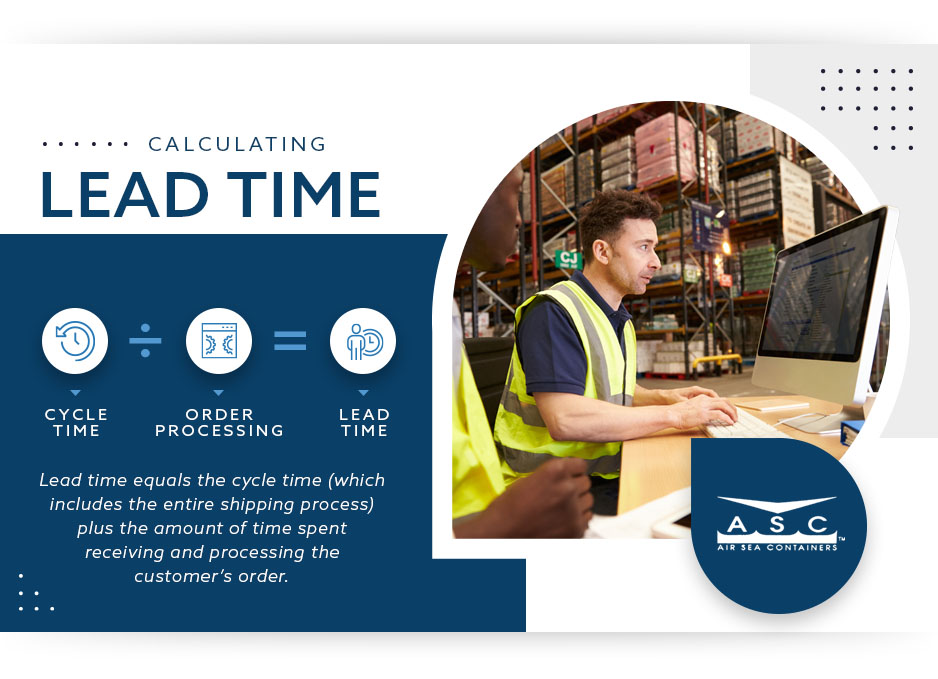
The best way to understand this concept is with this formula: Cycle time + order processing times = lead time.
- In shipping, lead time equals the cycle time (which includes the entire shipping process) plus the amount of time spent receiving and processing the customer’s order.
In other words, lead time calculation begins when the task appears in a company’s to-do list (when the customer places an order). Even if a company is fully aware of its lead and cycle times, a customer can only experience the lead time.
Example Lead Time Scenario: The Pizzeria
A simple way to demonstrate the difference between cycle times and lead times is when a customer orders a pizza from a restaurant. The customer calls the restaurant at 6 p.m. and receives their pizza at 6:35 p.m.
From the customer’s point of view, they have to wait 35 minutes until the pizza arrives at their doorstep.
From the restaurant’s point of view, they take the customer’s call at 6 p.m., adding it to the list of orders to be processed. The kitchen staff finishes previous orders, only starting the caller’s order at 6:15 p.m. and delivering it at 6:35 p.m.
Knowing that lead time equals cycle time plus order-processing time, we can determine the following:
- Cycle time: 20 minutes
- Order processing time: 15 minutes
- Lead time: 35 minutes
The Differences in a Nutshell
Another way to explain cycle time, Takt time and lead time is:
- The Takt time is what the company needs to do.
- The cycle time measures what the company can do.
- The lead time measures what the company does in practice, with all delays taken into account.
All three indicators are necessary to measure a shipping company’s performance. A shipping company that wishes to improve cycle times and lead times must first identify how long it takes to complete each step of the shipping process, find delay sources and address them.
Browse Our Shipping Barrels, Drums & Totes
Cycle Time vs. Lead Time in Shipping
The cycle time is the amount of time needed to complete a shipping process, from the starting point (the shipper’s address) to the final destination (the consignee’s address).
The lead time is the cycle time plus the amount of time between the consignee placing a shipping order and the shipper loading goods into the first transport vehicles.
Identifying and addressing delays during shipping makes the process shorter, improving both cycle time and lead time. Identifying processing delays before shipping begins may only improve lead times because the shipping process is unaffected.
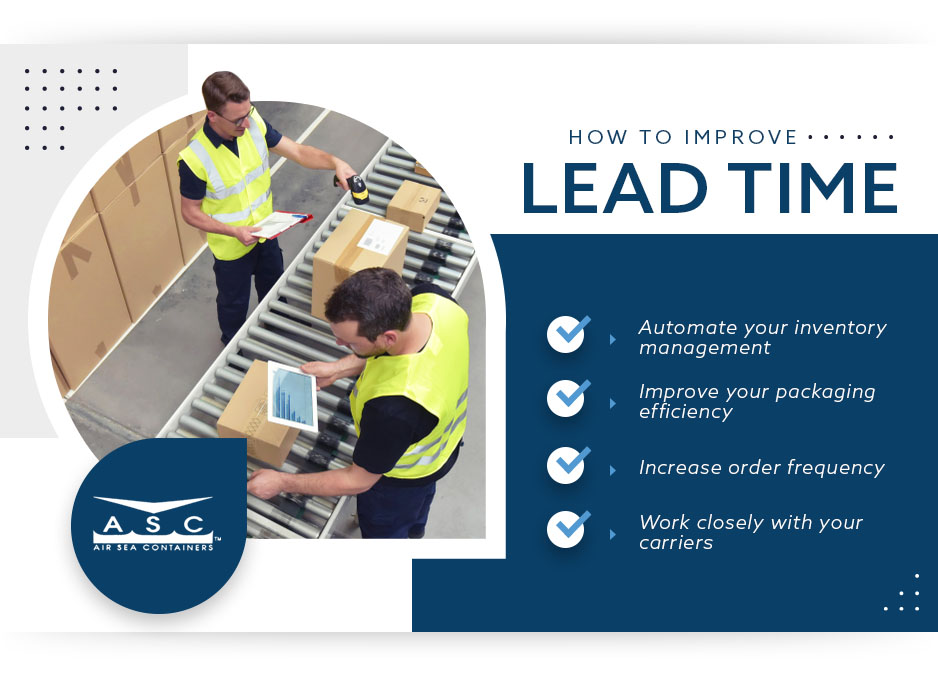
How to Improve Lead Times
Knowing the differences between cycle times and lead times, you may be wondering how to improve both, cut delays and ship packages to customers faster.
Shortening the cycle time is challenging, if not impossible, because many elements of the shipping process are out of your control. While switching to a faster courier can help land transportation, doing so usually requires paying higher fees. Additionally, the longer the distance a package must travel, the more incompressible limitations it may face, such as customs processing.
The best way to improve your lead times is to identify and address inefficiencies before your package is in the hands of a shipping company. In other words, you must determine whether you are processing orders, packing products and shipping them as efficiently as possible.
Automate your inventory management.
The most successful shipping companies understand the value of automation, which helps them reduce wasted time and eliminate inefficient processes. Examples of inefficiencies include paper-based tracking documents, manual data entry or the lack of an efficient warehouse workflow system.
Taking advantage of one of the many applications and inventory management software can help you improve your efficiency in all of the following areas:
- Letting a computer receive and notify you of new orders is always faster than a manual order processing system.
- Computerized inventory monitoring allows you to see what you have in stock at all times, helping you prevent stockouts and lost packages.
- Automated item picking and order fulfillment reduce time spent in the warehouse.
- Most such systems also offer real-time order tracking, letting you see what is where at all times during delivery and allowing you to communicate more accurate delivery ETAs to your customers.
Improve your packaging efficiency.

Standardizing the packaging you use as much as possible helps you cut packaging lead times and simplifies your logistics.
For example, if you ship hazardous materials listed in different packing groups, check your containers’ UN codes. Remember that a container suited for transporting materials in packing group I (highest hazard level) can also safely transport packing groups II and III (lower hazard levels).
Therefore, instead of stocking shipping barrels for each group, you may find it more time- cost-effective to use a single barrel type that can safely transport all packing groups.
If you rely on custom shipping boxes, always ensure you have a steady supply, especially if they are time-consuming to produce. Delays in packaging production can add significant lead time.
Increase order frequency.
Prioritizing large bulk orders over multiple smaller orders may seem like a good way to save money. However, larger orders take longer to ship, contributing to longer lead times.
Try taking on smaller and more frequent orders and compare the numbers. Even if the initial costs increase, the time saved may help you manage your inventory more efficiently, reduce lead time and increase customer satisfaction.
Work closely with your carriers.
Developing a close and mutually beneficial partnership with your carriers is vital for success. They must be able to deliver, and you must communicate everything they need.
Review your existing contracts with carriers and suppliers and check whether they deliver on their promises. If one of your suppliers has a history of late shipments, keeping them in your supply chain may be costlier in the long run than simply cutting them out and finding a different partner.
However, don’t forget to provide your partners with everything they need to be as fast and efficient as possible. Communicate often, provide customer data, pay them on time or in advance and share your delivery forecasts with them. Consider providing incentives or bonuses for packages delivered on time.
Use the Best Packaging for Shipping Your Products
Air Sea Containers is a family-owned provider of high-quality hazmat packaging with over 30 years of experience.
Whether you’re looking for boxes, drums, pails, totes or other container types, we have the products you need, compliant with all international shipping regulations. Let us be your packaging partner, and we can help make your logistics easy and worry-free.
Image Credits
davooda/Shutterstock.com
Mariya II/Shutterstock.com
skipper_sr/Shutterstock.com
Monkey Business Images/Shutterstock.com
industryviews/Shutterstock.com
vectorfusionart/Shutterstock.com
Andrey_Popov/Shutterstock.com
wavebreakmedia/Shutterstock.com