Sustainable Shipping: How the Shipping Industry Is Working Towards a Carbon-Free Future
- By Cory Levins
- 10 ene 2020

It’s no exaggeration to say that the shipping industry is the engine that powers global commerce. Over 90 percent of all global trade flows through the world’s shipping infrastructure, with goods carried to the far corners of the earth via enormous cargo ships hauling thousands of shipping containers at once. Those goods are then loaded onto trucks, trains and cargo vans to arrive at your home or business. It’s not magic—just a lot of very hard work and incredible technologies.
To call the shipping industry an engine is accurate in another way, however, it’s among the world’s biggest burners of fossil fuels. Now that the business community around the world can no longer afford to ignore global warming, the shipping industry is stepping into its role in reducing carbon emissions.
The road to a carbon-free future may be the shipping industry’s longest and most challenging journey yet. But the industry is now taking steps to demonstrate that it’s up to the challenge of protecting the planet while keeping goods moving. Enjoy this peek at the industry’s journey towards sustainable commerce—plus a few tips on eco-friendly shipping materials from Air Sea Containers.
The story of 20th- and 21st-century shipping has been one of ever-larger container ships, with today’s biggest models capable of holding well over 20,000 containers. All that capacity is great for bringing consumer prices down, but it also means that these super-sized ships are burning enormous amounts of carbon-rich fuel.
The most popular shipping fuel is heavy fuel oil (also known as bunker fuel), a thick, dirty and tar-like substance that’s created from the processing leftovers of other fuel types. Large cargo ships burn hundreds of tons of heavy fuel oil per day. It’s a cheap and effective fuel source, but it’s among the dirtiest and most carbon-intensive types of fuel.
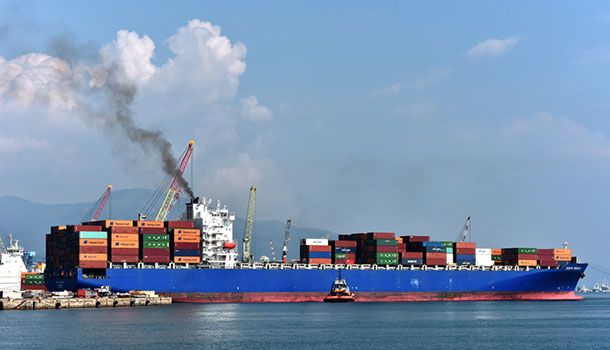
Where does that leave us in terms of greenhouse gas emissions? Experts say that two to three percent of the world’s annual GHG output is attributable to the shipping industry. That might not seem like much, but it’s roughly equivalent to the annual carbon emissions of a highly industrialized nation like Germany or Japan.
Why is it so important to develop a green and sustainable shipping industry? For one, climate scientists now agree that global industry has just a few decades to seriously scale back its carbon emissions before climate change causes irreversible disruption in human life. Thus, the international business community has a responsibility to step up and come together to fight climate change to preserve the world that we all share and do business on.
It’s also important to remember that sustainability offers significant bottom-line advantages. Reducing fuel consumption and creating more efficient and reusable shipping materials will ultimately allow businesses to save money and the environment at the same time. On top of that, studies show that consumers are willing to pay more for products that use sustainable production and supply chain processes.
There’s no room for the shipping industry to slow down. Between 2018 and 2023, some experts forecast an annual growth rate of four percent for the sector, and as the industry grows, emissions will grow along with it. To maintain the global commercial economy, radical change is needed in the technology and operations of the world’s shipping.
Fortunately, environmental standards are beginning to change, and new technologies are springing up to meet the challenge of emissions reduction. In 2018, the cargo regulators at the International Maritime Organization (IMO) finally signed a deal that agreed to halve the global shipping industry’s carbon emissions by 2050. Although the deal is non-binding, it sets out a framework for creating an enforceable rules system by 2023. In the coming years, the IMO will study emissions data from ships around the world to identify how to structure and enforce the new emissions rules.

What technologies will the industry use to create the necessary reductions?
Along with these exciting technologies and techniques, many climate experts also advocate market-based mechanisms such as carbon taxes to encourage the use of low- or no-carbon fuels. Industries can sometimes be slow to adopt new technologies, and carbon taxes encourage them to make the switch by making low-carbon fuels more financially advantageous.
One might expect strong pushback from the business community on carbon taxes, but in some cases, the opposite is actually true. Leading companies from BP to Ford Motor Co. to Capital One are now lobbying the U.S. government for a carbon tax, seeing the writing on the wall for the winding down of the fossil fuel industry and the need to embrace sustainable technologies.

Trucking is shipping’s sister industry, with hundreds of thousands of tractor-trailer trucks pulling shipping containers to their destinations. It’s also an industry that’s responsible for its fair share of carbon pollution. The average semi-truck gets just 6.5 miles per gallon of fuel, and with a single semi averaging 45,000 miles per year, it’s clear that the trucking industry is also badly in need of green solutions.
Hybrid and electric vehicles are already on the market and widely used, but they haven’t yet quite caught on in the trucking market. That’s soon to change as companies like Tesla roll out their plans for fully-electric semi trucks. Although cost may create initial barriers to adoption, rechargeable vehicles could create long-term savings for companies that invest in them.
For now, the most important innovations in the trucking industry are consolidation and efficiency practices that reduce the amount of time that trucks spend idling. By creating streamlined shipping routes and schedules, trucking companies can reduce strain on the environment, as well as expenditures of time and money.
Nearly all goods are shipped in some kind of packaging, and a lot of that packaging doesn’t break down naturally. Rather, it goes into landfills and oceans, where it can remain for a long time. While some common packaging materials, such as corrugated board, break down fairly quickly, others, such as polystyrene or Styrofoam, can take anywhere from 500 to a million years to degrade naturally.
On top of that, remember that most conventional plastics such as polyethylene are made from petrochemical feedstocks. Thus, petrochemical plastics still result in excess carbon entering the biosphere, even if it’s going into landfills and oceans, rather than into the atmosphere.

That’s why embracing biodegradable packaging and recyclable packaging is a key component of the shipping industry’s journey toward carbon neutrality. Packaging manufacturers now offer biodegradable plastic packaging materials made from a variety of natural materials, including versatile agricultural products such as corn oil.
These bioplastics are now widely available, cost-effective and just as good (if not better) at protecting cargo from damage in transit. They also reduce the amount of petroleum products used in creating plastics, which means more oil left in the ground and less carbon that enters the biosphere.
We’ve talked a lot about the big, industry-wide changes coming to the shipping sector, but what about the micro level? What can shippers start doing today to build an industry that’s both greener and more productive?
Air Sea Containers offers eco-friendly shipping supplies as a great way to get started. We offer an industry-leading selection of green shipping materials to help keep your goods safe no matter how you’re shipping them.

An industry as large and capital-intensive as shipping won’t go carbon-free overnight. However, thanks to the dogged efforts of researchers, activists and businesses–both small and large–around the world, the industry has taken the first steps on a path that leads to a zero-emission future. By protecting our shared environment and planning for a greener future, we’re making a critical investment in the future of the global economy.
To call the shipping industry an engine is accurate in another way, however, it’s among the world’s biggest burners of fossil fuels. Now that the business community around the world can no longer afford to ignore global warming, the shipping industry is stepping into its role in reducing carbon emissions.
The road to a carbon-free future may be the shipping industry’s longest and most challenging journey yet. But the industry is now taking steps to demonstrate that it’s up to the challenge of protecting the planet while keeping goods moving. Enjoy this peek at the industry’s journey towards sustainable commerce—plus a few tips on eco-friendly shipping materials from Air Sea Containers.
Why Shipping Is a High-Carbon Industry
The story of 20th- and 21st-century shipping has been one of ever-larger container ships, with today’s biggest models capable of holding well over 20,000 containers. All that capacity is great for bringing consumer prices down, but it also means that these super-sized ships are burning enormous amounts of carbon-rich fuel.
The most popular shipping fuel is heavy fuel oil (also known as bunker fuel), a thick, dirty and tar-like substance that’s created from the processing leftovers of other fuel types. Large cargo ships burn hundreds of tons of heavy fuel oil per day. It’s a cheap and effective fuel source, but it’s among the dirtiest and most carbon-intensive types of fuel.
Where does that leave us in terms of greenhouse gas emissions? Experts say that two to three percent of the world’s annual GHG output is attributable to the shipping industry. That might not seem like much, but it’s roughly equivalent to the annual carbon emissions of a highly industrialized nation like Germany or Japan.
The Need for Sustainability
Why is it so important to develop a green and sustainable shipping industry? For one, climate scientists now agree that global industry has just a few decades to seriously scale back its carbon emissions before climate change causes irreversible disruption in human life. Thus, the international business community has a responsibility to step up and come together to fight climate change to preserve the world that we all share and do business on.
It’s also important to remember that sustainability offers significant bottom-line advantages. Reducing fuel consumption and creating more efficient and reusable shipping materials will ultimately allow businesses to save money and the environment at the same time. On top of that, studies show that consumers are willing to pay more for products that use sustainable production and supply chain processes.
The Future of Green Shipping
There’s no room for the shipping industry to slow down. Between 2018 and 2023, some experts forecast an annual growth rate of four percent for the sector, and as the industry grows, emissions will grow along with it. To maintain the global commercial economy, radical change is needed in the technology and operations of the world’s shipping.
Fortunately, environmental standards are beginning to change, and new technologies are springing up to meet the challenge of emissions reduction. In 2018, the cargo regulators at the International Maritime Organization (IMO) finally signed a deal that agreed to halve the global shipping industry’s carbon emissions by 2050. Although the deal is non-binding, it sets out a framework for creating an enforceable rules system by 2023. In the coming years, the IMO will study emissions data from ships around the world to identify how to structure and enforce the new emissions rules.
What technologies will the industry use to create the necessary reductions?
- Reducing travel speed for cargo ships is one way to substantially and quickly cut fuel consumption, although a balance has to be kept with maintaining a reasonable level of speed and service.
- Biomass-derived fuels offer a more eco-friendly substitute for heavy fuel oil, and ships can burn them in the engines they already use. However, biofuels compete for production capacity with food and other agricultural products, meaning they’re likely more of a transitional technology.
- Low-sulfur marine fuels (LSMFs) are cleaner versions of the bunker fuel that ships already use, and the IMO will require all ships to switch to LSMFs by 2020. Challenges remain in ensuring that sufficient supplies of LSMFs are available for all the vessels that need them, which is why shipping giants like Maersk have formed partnerships with fuel companies that produce and distribute these cleaner fuels.
- High-tech synthetic fuel systems such as hydrogen fuel cells are the cleanest and greenest of all, but they’re currently used only by smaller ships. But as the IMO’s deadlines for low-emissions fuel get closer, expect to see an investment boom in these next-generation fuels. Hydrogen fuel cells are already on their way to becoming cost-competitive, and clean technologies like wind power can be used to generate the necessary fuel.
Along with these exciting technologies and techniques, many climate experts also advocate market-based mechanisms such as carbon taxes to encourage the use of low- or no-carbon fuels. Industries can sometimes be slow to adopt new technologies, and carbon taxes encourage them to make the switch by making low-carbon fuels more financially advantageous.
One might expect strong pushback from the business community on carbon taxes, but in some cases, the opposite is actually true. Leading companies from BP to Ford Motor Co. to Capital One are now lobbying the U.S. government for a carbon tax, seeing the writing on the wall for the winding down of the fossil fuel industry and the need to embrace sustainable technologies.
Green Shipping in the Trucking Industry
Trucking is shipping’s sister industry, with hundreds of thousands of tractor-trailer trucks pulling shipping containers to their destinations. It’s also an industry that’s responsible for its fair share of carbon pollution. The average semi-truck gets just 6.5 miles per gallon of fuel, and with a single semi averaging 45,000 miles per year, it’s clear that the trucking industry is also badly in need of green solutions.
Hybrid and electric vehicles are already on the market and widely used, but they haven’t yet quite caught on in the trucking market. That’s soon to change as companies like Tesla roll out their plans for fully-electric semi trucks. Although cost may create initial barriers to adoption, rechargeable vehicles could create long-term savings for companies that invest in them.
For now, the most important innovations in the trucking industry are consolidation and efficiency practices that reduce the amount of time that trucks spend idling. By creating streamlined shipping routes and schedules, trucking companies can reduce strain on the environment, as well as expenditures of time and money.
The Impact of Packaging
Nearly all goods are shipped in some kind of packaging, and a lot of that packaging doesn’t break down naturally. Rather, it goes into landfills and oceans, where it can remain for a long time. While some common packaging materials, such as corrugated board, break down fairly quickly, others, such as polystyrene or Styrofoam, can take anywhere from 500 to a million years to degrade naturally.
On top of that, remember that most conventional plastics such as polyethylene are made from petrochemical feedstocks. Thus, petrochemical plastics still result in excess carbon entering the biosphere, even if it’s going into landfills and oceans, rather than into the atmosphere.
That’s why embracing biodegradable packaging and recyclable packaging is a key component of the shipping industry’s journey toward carbon neutrality. Packaging manufacturers now offer biodegradable plastic packaging materials made from a variety of natural materials, including versatile agricultural products such as corn oil.
These bioplastics are now widely available, cost-effective and just as good (if not better) at protecting cargo from damage in transit. They also reduce the amount of petroleum products used in creating plastics, which means more oil left in the ground and less carbon that enters the biosphere.
Eco-Friendly Shipping Supplies from Air Sea Containers
We’ve talked a lot about the big, industry-wide changes coming to the shipping sector, but what about the micro level? What can shippers start doing today to build an industry that’s both greener and more productive?
Air Sea Containers offers eco-friendly shipping supplies as a great way to get started. We offer an industry-leading selection of green shipping materials to help keep your goods safe no matter how you’re shipping them.
- Biodegradable Packing Peanuts: These plant-based packing peanuts are made from an eco-friendly and biodegradable sealed air material rather than Styrofoam, and they offer superior performance and an anti-static design that makes them an excellent choice for many different types of cargo.
- Opus Biodegradable Air Pillows: The Opus Air Pillow system is a revolutionary innovation for block and brace void fill protection, offering 100 percent biodegradable construction with the superior performance of high-density polyethylene. Reuse, recycle or even compost them when you’re done.
- Reusable Refrigerant Gel Packs: Tired of dealing with the shipping challenges of dry ice? These gel packs are reusable and completely non-toxic for a sustainable and environmentally friendly cargo cooling solution.
- Custom Corrugated Shipping Boxes: Corrugated board is both a durable shipping material and a great environmental choice. It hangs tough for all kinds of shipping, but it also biodegrades in only a few months after disposal. Air Sea Containers’ custom corrugated shipping boxes are ideal for right-sizing your shipping, and by reducing the weight of the materials used, they can even potentially create fuel and shipping cost savings for your business.
- Spill Containment Materials: Another part of environmentally responsible shipping is ensuring that hazardous chemicals aren’t allowed to spill into the environment. Air Sea’s spill containment materials, like our spill containment trays and spill containment pallets, are ideal for keeping chemical spills corralled and are constructed from eco-friendly EcoPolyBlend plastic.
- MARPOL Guides: The IMO’s marine pollutants rules, known as MARPOL, are a critical tool for helping shipping companies understand how to keep our oceans clean and stay in compliance with IMO rules. Air Sea offers the complete MARPOL guidelines in bound form, including the MARPOL Consolidated Edition for easy reference.
- Emergency Response Guidebook: The Emergency Response Guidebook is the industry standard for practical response procedures to hazmat spills. Keep copies on hand in warehouses, vehicles and any other hazmat handling areas to ensure that your employees have a detailed blueprint for handling an environmentally toxic spill.
- Used Shipping Containers: With millions of shipping containers sitting unused around the world, many businesses are looking for savings. Air Sea can help your business find a great rate on a used shipping container. We offer both 20-foot shipping containers and 40-foot shipping containers, high cube and water tight container options and fast delivery straight to your business.
An industry as large and capital-intensive as shipping won’t go carbon-free overnight. However, thanks to the dogged efforts of researchers, activists and businesses–both small and large–around the world, the industry has taken the first steps on a path that leads to a zero-emission future. By protecting our shared environment and planning for a greener future, we’re making a critical investment in the future of the global economy.