
How Digital Innovation Is Changing the Shipping Industry
- By Cory Levins
- 16 may 2017

The shipping industry is one of the backbones of the global economy. It is no surprise then, that companies are investing heavily in new technologies and innovative systems to help increase delivery time and overall efficiency in this largest of industries. With just a quick scan of the tech and businesses sections of popular publications, you can see how technology in the shipping industry is a preview of how businesses will operate in the future.

ROBOTS
There could be an argument made that shipping warehouses provide the perfect testing ground for robot labor. Amazon is one company leading the charge. Since buying a fleet of robots in 2012, Amazon has continuously looked for new ways to make the shipping process more efficient.
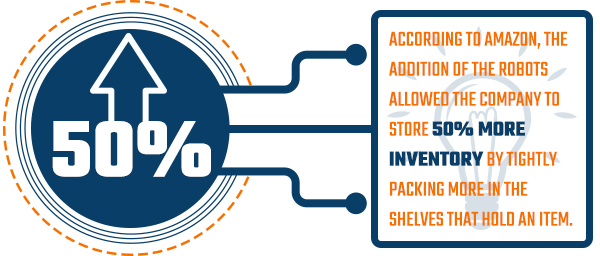
As reported by CNN Tech, late last year, Amazon now only needs a minute of human labor to ship your next package. The process is efficient, futuristic, and beautifully simple. According to Amazon, the addition of the robots allowed the company to store 50% more inventory by tightly packing more in the shelves that hold an item.
Before the addition of robots, when an order was being fulfilled a worker had to walk and find the item among the multiple shelves in the Amazon warehouse. This, understandably, took a lot of time and energy from the employee. The addition of the robots helps to solve that problem.
The robots are now programmed to find an item, lift it from the shelf, and bring it to the employee for packaging. Once the robot has delivered the item, it is designed to immediately go and “pick” the next item. This next generation of the assembly line is helping Amazon provide services such as “free two-day shipping” to its Prime members.
Robots are not the only innovative technology being used by Amazon in its shipping facilities. Amazon has also developed improved automatic technology to help speed up the handling process. When the robot delivers an item to the employee, it does so in a yellow bin. These yellow bins are designed to inform an employee what size packaging the item requires.
 As reported by CNN Tech, the employee only needs 15 seconds to assemble the right box, add bubble wrap, tape the package, add a barcode, and put it back on a conveyor belt. This is made possible by automated processes such as a machine that will provide the perfect amount of tape to the employee for the size box he or she is assembling.
 Robots are playing a large part in shaping the shipping industry, and robotics manufacturer OptoForce is one of the companies leading the charge. According to Packaging Digest, the company just announced that they are equipping robots with a sense of touch.
In regards to packaging applications, robots equipped with the sensor will now be able to perform tasks like inserting glossy paper cartons into shipping boxes, where it is important that you don’t scratch the surface, and this could prevent package damages with the palletizing of fragile objects.
DRONES
Drones are certainly a trendy topic at the moment, and it is easy to see their appeal to the shipping industry. Many major companies are investing in drone technology, with Amazon and DHL leading the way.
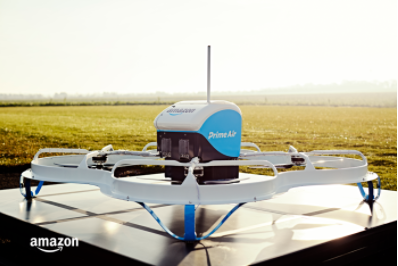
Amazon recently launched its Prime Air service, a delivery designed to safely get packages to customers in 30 minutes or less using unmanned aerial vehicles (aka drones). According to Amazon, the Prime Air service promises to provide rapid parcel delivery that will also increase the overall safety and efficiency of the transport system.
The service is currently in testing phase, and Amazon completed its first test delivery back in December. Amazon said the test took 13 minutes from the customer clicking “order” to the package being delivered—which was an Amazon Fire TV and a bag of popcorn.
 According to an article in the New York Times, if the Prime Air service is a success, it could open up a new autonomous future for Amazon. Drones could be combined with warehouses manned by robots and trucks that drive themselves. A decade from now, drones would reduce the unit cost of each Amazon delivery by about half, analysts at the Deutsche Bank projected in a recent research report.
Amazon and other companies still need to work with lawmakers around the world to ensure that drone delivery is safe and regulated. Amazon is making headway with various countries around the world, and we should see them expanding their testing markets over the course of the year.
Despite legal hurdles, Amazon is still applying for patents for a range of drone-based technologies. While the company is secretive about their plans, a look at their recently filed patents lends clues as to what Amazon potentially sees in its future. CNN recently reported that the U.S. Patent and Trademark Office granted Amazon a patent for a method to guide packages released from drones safely to the ground.
In order to deliver the package, the drone would use magnets, parachutes, or spring coils to release the delivery while in mid-flight. This makes sense, as one of the logistical problems drones face is the potential to hit people, property, or animals. If they stay in the air, this could be one solution to avoid running into obstacles. At this stage, all we know is it is just an idea, but it does show that Amazon is serious about the future of drone technology.
One incredibly futuristic patent filed by Amazon involves a floating warehouse. According to Air Space Magazine, Amazon recently filed a patent for a giant floating warehouse from which small drones could travel to-and-fro in order to grab parcels and deliver them to their destination. The patent isn’t full of details, but it suggests that the plan is to have a large floating warehouse kept afloat by helium or hot air that would hover 45,000 feet above sea level.
Amazon isn’t the only company looking into drone technology. Google and massive logistics companies like DHL are looking at ways they can use drones. As reported by Popular Science Magazine, just last year, the company built a carbon fiber tilt-rotor drone that takes off like a helicopter and flies like a plane. The parcelcopter, as it’s aptly named, can fly at least five miles carrying 4.4 pounds of cargo at a speed of over 40 mph. It was tested in the Bavarian mountains and flew in eight minutes a trip that takes cars half an hour.
AUTONOMOUS SHIPPING VEHICLES
Another big innovation in the shipping industry is the move toward autonomous vehicles. The biggest push for autonomous vehicles is with self-driving cars and trucks. Uber is one company leading the way, with the acquisition of Otto, a self-driving technology company.
According to the American Trucking Association, about 70% of the domestic freight tonnage was carried by trucks. Uber, with their new self-driving department, decided to invest in solutions that can combat the dwindling number of human truck drivers and thousands of preventable accidents each year with self-driving freight trucks.
The Uber website states they are committed “to improve the safety and efficiency of the trucking industry.” In October of last year, Uber completed the world’s first autonomous truck delivery. As reported by Wired.com, the delivery consisted of 50,000 cans of Budweiser beer from the brewery in Fort Collins, CO to Colorado Springs.
 Currently, the technology only works on the highway and requires a driver to be present. Until the technology has developed safer ways to deal with things like pedestrians and cross traffic, autonomous trucks will act almost like a train until the driver needs to exit the highway. Then he or she will guide the truck to its final destination.
 Autonomous delivery vehicles aren’t just limited to trucks and vans. Domino’s Pizza in Germany and the Netherlands recently partnered with Starship Technologies to create small delivery robots that will deliver your pizza. As reported by Inc.com, the delivery robots will deliver pizzas to consumers who live within a one-mile radius of local stores.
The robots are designed to climb curbs, travel over grass, and steer clear of people, animals, and other obstacles. Legislation is one hurdle delivery robots need to pass, but Virginia and Idaho have already legalized delivery bots statewide with many states set to follow. While this technology is currently focused on food delivery, it is easy to see how it can be used for shipping small parcels, as well, from local distribution centers.
The autonomous technology is also being used by cargo ships. Late last year, the Kongsberg Group, an international technology group that supplies high-technology systems and solutions to customers in the merchant marine and other industries, announced plans to build the world’s first “unmanned and fully automated vessel for offshore operations.”
 As reported by The Maritime Executive, the ship is designed to be a light-duty offshore utility ship for cargo deliveries to offshore installations, as well as a number of other functions. Currently, laws and regulations prohibit the sailing of unmanned vessels, but Kongsberg is working with lawmakers and regulators to develop safe rules and procedures to govern autonomous vessels.
 In addition to automated ships, one company is working on plans for a large, autonomous drone. As reported by NBC, a startup in California’s Bay Area called Natilus Inc. is currently developing a large autonomous drone capable of moving freight across the Pacific Ocean more cheaply than conventional piloted cargo planes and faster than cargo ships.
The company hopes it can find a good middle ground between cargo planes and cargo ships. If a company wants to ship goods quickly over the Pacific, they traditionally need to choose a cargo plane option. Goods can arrive within a day (depending on the location) but at a substantial cost.
Cargo ships are the other options, but it can take weeks for goods to arrive. With an autonomous drone, Natilus Inc. believes they can ship goods from Los Angeles to Shanghai in 30 hours at a cost of about $130,000. That’s almost half the price of the same route via a cargo plane. With companies constantly looking at quicker and less expensive means of transport, we soon could see these large drones in the sky.
BLOCKCHAIN TECHNOLOGY
If you haven’t yet heard of blockchain technology, there is a big chance you will in the future. Matthew Wall of the BBC describes blockchain technology as “a method of recording data—a digital ledger of transactions, agreements, contracts—anything that needs to be independently recorded and verified as having happened.”
It is useful in the way it records and keeps track of assets or transactions across industries. You may sit there and wonder “What the is the big deal”? The excitement around this technology lies in its multiple applications. The financial sector was one of the early adopters of this technology.
 According to Simon Taylor, vice-president of blockchain research and development at Barclays, “If banks started sharing data using a tailor-made version of blockchain, it could remove the need for middlemen, a lot of manual processing, and speed up transactions.”
Blockchain technology allows for the analysis of data by a set of computers and for companies to easily share data within their own company or with others. Many other businesses are jumping on the bandwagon, the shipping industry included.
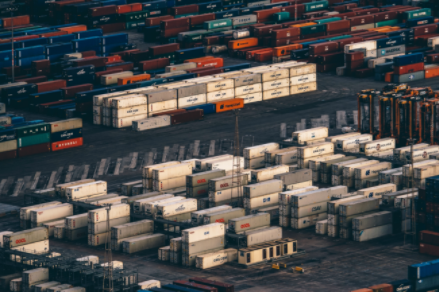
As reported by Reuters, IBM and a Danish transport company Maersk stated they were working together to digitize, manage, and track shipping transactions using blockchain technology. The two companies believe they can create a system using blockchain technology that can manage and track the paper trail of tens of millions of shipping containers globally. This will help the shipping industry become more efficient and will increase transparency.
CONCLUSION
The advancements in digital technology are ever-changing. With additions of robots, drones, autonomous vehicles, and blockchain technology, the shipping industry, as we know it, is set for drastic change.


