How Blockchain Will Impact Hazardous Materials Handling
- By Cory Levins
- 9 ago 2019

It’s an exciting time for the global supply chain. Shipping has never been faster and more efficient, and the selection of goods around the world has never been wider. The logistics field is in an incredible state of technological and economic advancement, and at Air Sea Containers, we’ve been pleased to see so many of our customers flourish and expand.
However, as these advantages increase, so do the potential issues that come with them. Transparency, system integration, safety, accountability, security and, of course, cost-consciousness. These needs have always been present, and the new reality of global logistics has brought them into sharper focus. The stakes for hazmat shippers are high, but there’s another name on the horizon with a lot of buzz: blockchain.
Blockchain technology has the potential to revolutionize nearly everything systems that power global logistics. You’ve probably heard a lot of excitement bubbling up around this technology lately, but how does it work, and what’s its outlook for the future of hazmat shipping? Staying up on current trends and exciting tech is part of the job for a hazmat shipper, and at Air Sea, we love investigating the latest innovations that can help our customers. Here’s a quick primer on blockchain technology and how it could be a game-changer for hazmat shipping.
What Is the Blockchain?
Bitcoin and other cryptocurrencies—decentralized and anonymous currencies traded through the Internet—have become household names in recent years, and you’ve probably heard that they’re based on blockchain technology. However, blockchain has many uses outside of cryptocurrency markets.
Cryptocurrencies put blockchain to work by using it as a ledger technology to track transactions and ensure accountability. That technology, as it turns out, can be easily applied to more mainstream industries as well. The basics of the technology work like this:
- Information is stored as a series of “blocks” distributed across a network between everyone with access to the blockchain. This information can be nearly anything: accounting records, inventory, certificates, correspondence or numerous other types of data depending on the structure of the blockchain.
- Each block contains data, but it also contains hash values—generated strings of code that can be used to verify the data—as well as a piece of the hash value from the previous block. Thus, since each block in the chain “points” at another block, it’s very hard to alter information in a previously created block.
- New blocks are periodically added to the chain as users create more data. Users have private keys that they use to identify themselves and electronically sign transactions.

Many different blockchains exist, and many have additional technologies built into them (such as the Ethereum blockchain’s Solidify language, which allows the execution of smart contracts). There’s no doubt that the technology is on its way up, with all kinds of major players in the business world starting to show real interest.
That brings us to the big question: What are the problems in hazmat shipping that blockchain technology could provide solutions for?
What Are the Key Challenges That Blockchain Can Help With?
Many businesses are searching for technologies that allow them to address the biggest challenges in hazmat logistics. Blockchain offers several major improvements that make its technologies appealing:
- Transparency: In hazmat logistics, dealing with unscrupulous or unqualified vendors can have serious consequences, and it’s equally important to maintain internal transparency. By creating an unalterable record distributed among many users, a blockchain facilitates much greater transparency and makes counterparty risk evaluations easier.
- Efficiency: Logistics operations often have trouble “running lean.” Large amounts of paperwork and inefficiencies in electronic data interchange (EDI) systems mean that many transactions are slower and less streamlined than they should be. For businesses that can get their suppliers and vendors into a standardized blockchain framework, great gains in efficiency are possible.
- Collaboration: The highly efficient nature of blockchains as data access points means that information can be shared quickly across a wide network. That easy access can help create an environment that facilitates collaboration and makes it easier to get numerous stakeholders on the same page quickly.
- Cost-Consciousness: Between a historic capacity crunch and the ever-present costs associated with shipping hazardous materials, companies with hazmat shipping interests are always looking for ways to trim their budgets. When implemented properly, blockchain has the potential to reduce costs through reduced banking fees, theft prevention and other methods.
What are the use cases that could transform these principles into the future reality for hazmat shippers? Although these technologies are still in their emergence phase, particularly for more mainstream industries, big things could be on the horizon.
Four Big Ways Blockchain Will Impact Hazmat Handling
There’s no shortage of ideas for applications of blockchain. From medical records to financial records to notarization, distributed ledger technology has the potential to impact nearly every kind of data. Let’s look at four big applications of blockchain tech that have the most potential to shake the world of hazmat logistics—along with some key concerns that still need to be addressed before they become truly viable.
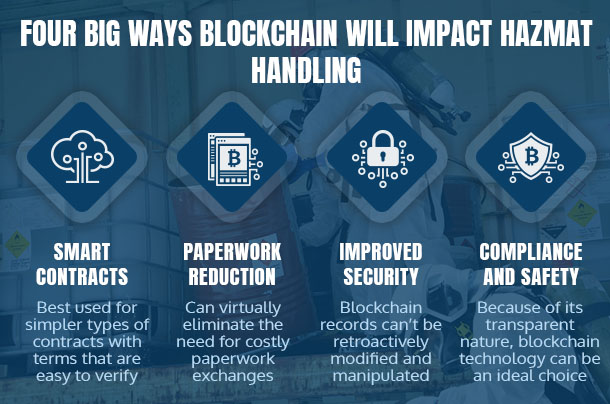
1. Smart Contracts.
Smart contracts are one of the most exciting new uses of blockchain technology. They’re a major feature of cryptocurrencies like Ethereum but can be used on other blockchain platforms as well. These contracts are actually small software programs that are embedded in the blockchain.
When two or more parties create a contract, they establish the terms by writing them into the blockchain using a smart contract language such as Solidity. In order for the contract to be fulfilled, certain conditions must be met and verified. Until then, the blockchain holds the currency in escrow. Once the blockchain has certified that conditions have been met, the contract will execute, funds will be transferred, and the transaction will be recorded. The terms can’t be altered once the contract is in the blockchain, so businesses can feel secure that it won’t be changed without their knowledge.
Smart contracts reduce the need for lawyers, notaries and the other accessory parties in creating and executing a contract. Instead, the contract can be evaluated and executed by an impartial digitized process. That means that smart contracts also face the significant challenge of designing programs that are flexible enough to accommodate a wide variety of terms—something the industry is hard at work on now. For now, smart contracts are best used for simpler types of contracts with terms that are easy to verify and simple enough to be easily programmed.

2. Paperwork Reduction.
One of the biggest obstacles to efficiency in hazmat transport is the mountain of paperwork required for nearly any hazmat-related transaction. Bills of lading, hazmat shipper’s declaration forms, IATA and IMO forms—the list goes on, and changes are frequent. Of course, much of this paperwork is necessary to ensure the safety of everyone involved, but it’s also a big barrier to efficiency and consumes a lot of person-hours.
Blockchain has the potential to massively improve the state of hazmat shipping paperwork thanks to its integrated ledger that’s automatically updated across the system. This can virtually eliminate the need for costly and time-consuming paperwork exchanges through faxes and email. Instead, blockchain users have access to a distributed ledger that automatically compares itself to every other copy on the network, helping to prevent paperwork errors from being replicated and propagating themselves.
On the flip side, blockchain is as vulnerable to human error as any other system. The “garbage in, garbage out” problem has been present since the beginning of digital data systems If someone enters data incorrectly, it’s just as big of an issue in a blockchain as in a traditional data system. In some ways, blockchain systems are actually more vulnerable to this, since they don’t allow data to be corrected in the record. However, blockchain systems do tend to make errors easier to discover and trace back to their source. And, like other “append-only” styles of database, the flawed data don’t have to disrupt the end-user experience. The important part is that the flaws are noted and visible for anyone who needs to go back and check.
3. Improved Security.
Tight security is critical when you’re dealing with dangerous goods. Physical paperwork always presents security risks, such as being intercepted in the mail. Electronic data transmission isn’t always much better, as the many recent large-scale data breaches demonstrate. Blockchain presents a great alternative for security improvements in the hazmat supply chain.
First, the obvious advantage: Blockchains are designed to be immutable, so records can’t be retroactively modified and manipulated. In addition, blockchain databases are heavily encrypted, and each user has a personal “key” that allows their access to be traced. That key is used to electronically sign transactions and provide a digital footprint of where each individual has created records in the system. It’s a great tool for preventing records from being manipulated inappropriately, and its improved accountability is also tremendously helpful in tracing the source of a discrepancy—a vital practice in an industry with very little margin for error.
However, the structure of the blockchain itself is its greatest security feature. Because it’s stored in a decentralized peer-to-peer network distributed over numerous different computers, it’s considerably harder for a hacker to access and control. An attacker typically needs access to at least 51 percent of the network’s computing power to gain control of it—so, while attacks are not impossible (particularly on smaller blockchains), they’re considerably more difficult to execute.
4. Compliance and Safety.
Because of its transparent nature, blockchain technology can be an ideal choice for compliance and safety programs. Any given batch can be more easily traced to its origin, damaged shipments can be followed back through their journeys and certificates and documentation can be accessed quickly. The food and beverage industry is setting an example: Walmart, Nestle, Unilever and many other consumables companies have joined the Food Trust Blockchain, an initiative to standardize food safety and traceability protocols. In the hazmat industry, meanwhile, some pioneering companies have started to implement blockchain tracking systems with scannable QR codes to improve safety in the recycling of hazardous materials.
Of course, this transparency requires greater standardization of blockchain than currently exists—another challenge that the industry is working to overcome. Transparency and easy data access are major features of blockchain technology, but they require interoperability. If a vendor and a buyer are working in different blockchains, it’s often almost impossible to exchange assets across the gap. Some projects for cross-blockchain transactions are in the works, but until their technologies bear fruit, businesses will continue to pursue integrative solutions to the siloing effects created by separate blockchains.
Thus, when you’re dealing with hazardous materials, it’s best to keep relying on the tried and true. Applying the proper hazmat labels and hazmat placards to your goods is still essential for safe handling, and keeping proper hard copies of records such as dangerous goods declarations will help ensure that they’re in an accessible form when you need them.

The Bottom Line on Hazmat Blockchain
Blockchain is an amazing technology with numerous applications. Some of them, such as those described above, will almost certainly have a big impact on the way hazardous materials are shipped, stored and traded. Blockchain has big potential to break down barriers in efficiency, security and trust.
However, it’s still an extremely young technology, with many iterations and improvements still to come. While it’s worthwhile to start investigating your options, be wary of anyone promoting blockchain as a “silver bullet” that will solve all of your hazmat shipping problems. Hazardous materials shippers need to be more careful than most about which technologies they invest in, so do your homework rigorously and don’t buy into the hype until you’re sure the technology is right for your business.
As the technology of hazmat shipping continues to evolve, Air Sea Containers will be there to provide our customers with the latest and best solutions. We’re excited to see the benefits that blockchain technology can offer to hazmat shippers around the world—but even after we’re all living in tomorrow’s digital utopia, we’ll keep providing the hazmat packaging solutions for every hazard class that keep your business safe and profitable.